Wednesday, January 30, 2019

Windows

Modern windows and their construction, both in India and the US, have bothered me quite a bit for the following reasons:

- Window sills, whenever they exist, are on the outside of the building. These sills are rendered useless, collecting dust and debris.
- The placement and height of the windows ensured that we stared at the walls when we sat on the floor and never could enjoy the view, defeating the very purpose of having those windows there.  Since we preferred floor seating, this issue was nagging me constantly.
- Elaborate window grills are maintenance nightmares.
- Windows with glass panes let in heat even when they are closed.
- Window panes are too big; there is no way to open small portions.
- Windows that are flush with the wall seemed to me like incomplete construction.

So I decided to understand windows very well, before we started our house construction.

Our architect Mr. Sudhir, founder of Peoples Architecture Commonweal (www.commonweal.in), specializes in vernacular architecture. He insisted on us visiting many local traditional houses and gaining understanding on how and why things were done the way they were.

On close observation, I realized that the windows in old, traditional style houses in our village differed quite a bit from the ones in new houses and also had addressed many of my concerns. I wrote about these houses here:

With aesthetics and utility in mind, I started fervently reading Christopher Alexander’s book “A Pattern Language” and found it to be a great resource in designing our house. Here I illustrate the features of our house that are in line with the patterns in this book.

Most of our windows are 18” from the floor. They are all used; procured from building demolition sites. All our windows have four panes; two top panes and two bottom ones (pattern 239-Small Panes). The panes are solid wood. In some windows, the small non-operable part at the top is glass. Our walls are 15” thick; 50% thicker than normal brick walls (pattern 197-Thick Walls, pattern 223-Deep Reveals). This is because of the outer skin of burnt bricks that is covering the inner adobe bricks. The thickness of the walls  provides ample sill space. In some places we have extended this sill space to achieve window seating (pattern 202-Built-in Seats). Christopher Alexander says:  "windows that create “places” next to them are not simply luxurious, they are necessary" (pattern 180-Window Places).

A built-in bench by the window in the living area

A built-in bench by the window, connecting kitchen and dining spaces

A built-in window seat

This built-in bench merges with the window sill

Kitchen Window

The kitchen window sill merges with the counter


From Christopher Alexander’s book, I learned that not all windows have to be of the same size. Also, in some places it is not appropriate to have big windows. This was the case in our corridor connecting the two rooms. We have a small window here offering a glimpse of the easterly view,  as in pattern 134-Zen View. 


I enjoy these window places so very much.

-- Hema

Friday, January 18, 2019

Vignesh

In this post I will showcase the work of a talented 15 year old friend of ours. Vignesh came to me last year to learn English. Like the other kids in our rural neighbourhood he was shy in the beginning, but unlike them he was also thoughtful and sensitive. Over time we found out he was good at sketching, painting, clay modelling, and cooking, largely self-taught. Once in a while he brought some of his creations to my “English class”. I was pleasantly surprised at the quality of his clay pieces despite the rough material involved. The material used in all the pieces shown is just unfiltered clay harvested from a local pond.

The following two pictures are of Vignesh’s self-portrait.


During the course of our English classes I got to know him better. He told me that since he was in X grade he was being forced to go for private tuition, both before and after school hours. Thus he hardly had any time for himself. He expressed his oppressive situation in the sculpture below, which shows two school children with wings attached but begging for freedom to fly.


Children enjoying each other’s company.


For Ganesh Chaturthi, Vignesh’s Ganesha falls prey to the modern lifestyle.


A more conventional Saraswati for Navratri.


More deities for the local festivals.


Once when the squirrel foundling that Abhi and Aparna were raising suddenly died, Vignesh made this clay squirrel below to help them deal with the loss.


Since we found his talent exceptional, we made arrangements for him to host a few sessions in Chennai where Vignesh got to share his clay modelling skills.


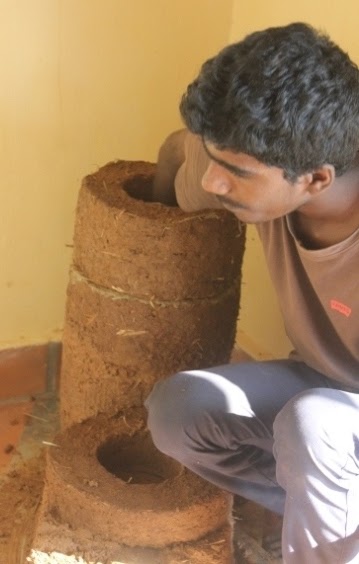
Here he is helping with a rocket stove that we built recently.


Vignesh is out of school and currently enrolled with NIOS (National Institute for Open Schooling) for his Senior Secondary (XII grade) exams. He thus has plenty of time to pursue his interests.

Saturday, October 20, 2018

Our House At The Farm


Main Entrance


Living Room and Kitchen


A bedroom on either side of a thin, long corridor


Window Seat


Attic


Compost Toilet


Vegetable bed at the back


Our chickens, Rakhi and Vellam, in a pen


Wednesday, June 13, 2018

Musical Connections


The other day, I went to the town of Chittoor, in the neighbouring state of Andhra Pradesh. It is about an hour and a half on the bus. The route is scenic, with rolling hills, mango orchards, coconut groves and small villages. Life on this route seems slower and more laid-back than in rural Tamilnadu. 

My chores done, I was ready to head back in the afternoon. When I boarded the returning bus, I saw two ladies who seemed a little familiar. After a closer look I realized that they had been there on the bus with me earlier that morning. Mutually surprised, we greeted each other and shared a three-seater. Their names were Vani and Asha. They knew three languages – Telugu, Tamil and Urdu. After a little chit-chat about our whereabouts and families, I retreated into my window space.  I was feeling a bit queasy about these two ladies checking me out with a lot of curiosity. My bare toes, neck and arms do tend to make people uncomfortable. I don’t wear the accessories that married women typically do. 

Looking for a distraction, I decided to sing to myself. Turning towards the window, I started to sing. The song that then came to my mind was “jeeye to jeeye kaise” from a Hindi film called “Sajan”. In a few seconds, I heard them mutter behind me, “She is singing in Hindi!” They crept closer to hear better. From the corner of my eye I could see Vani singing along. Happy to see her reaction, I continued singing. Once I was done, they expressed their delight and asked me for another. I sang “is mod se jaate hain” and “tere bina zindagi se” from “Aandhi”.  These are my absolute favorite movie songs in Hindi. 

In between singing these songs, we exchanged stories about our lives. I came to know that they were both twenty years younger than me.  They were illiterate. They were into making beedi (handmade thin cigarette, made by rolling dried tobacco leaves). As is typical in these parts, they had gotten married early, in their mid-teen years, and had children soon after. They heard the bits and pieces of my story with wonder and disbelief written on their faces. 

I enjoyed singing with Vani. She had a sweet voice and carried the tunes quite well.  She wanted to sing more. The age gap between us limited the number of songs we had in common., but thankfully we still had enough to keep us going for the next quarter hour. Although Vani was shy and kept covering her face with her shawl, she just couldn't suppress her desire to sing. Asha, on the other hand, couldn’t overcome her shyness; she mostly buried her face on her lap and would occasionally pop up to flash shy, overwhelmed smiles.

Our singing obviously attracted the attention of some co-passengers. Vani couldn’t be denied; she wanted to sing and she did exactly that. Soon it was time for them to get off the bus. We exchanged phone numbers and parted ways with a promise to visit each other’s villages.

*

I am not a singer, but I love to sing. I like Indian classical music and melodious movie songs from olden times, both Tamil and Hindi. Dev and the kids have been learning Hindustani vocal music from Warren Senders (www.warrensenders.com). Over a period of time, I have slowly picked up the songs they learn from him. I sing when I am working at home or the farm, or while traveling. 

These days, even in rural places like ours, music is consumed and never produced. People listen to music on their hand-held devices. We are surrounded by temples that have installed loud speakers that blare music from early morning on many days. The loud music played on private buses is often awful. Folk music has disappeared. Making music or singing together is no longer a part of the culture. It seems like the younger generation hasn’t really seen or heard people sing. I have been frustrated for long about this situation.

One day I decided to sing on public transport. The concept of “private space” is non-existent in Indian public transport because of the very high volumes of traffic it serves. Also the ambient noise on buses and trains is quite high – rattling windows and shutters, chitter-chatter of the passengers, cries of unhappy babies, music played on the bus, music played by the passengers on their mobile phones etc. Thus I knew that I won’t be “intruding” in to that non-existent, quiet, personal space. I sing on buses, trains and shared taxis (called "share auto"), not just because I like to; but also because I want to instill the long lost spirit of singing in others. I want them to think that they can sing too. I want them to experience the joy of singing.  

I am aware of the fact that often I am not anywhere close to being good at what I am singing. I realized that if I were to wait for perfection it may take an eternity! It took me a while to shed shyness and anxiety to sing in an unsolicited manner in a public space.When I sing, I make sure that only a few people who are close enough can hear me. Also, I don’t sing incessantly; I sing for brief periods with sufficient gaps of silence, just so my neighbours get a break from me.

People have responded in many ways to my singing. Indifferent, surprised, dumb-founded in utter disbelief, approving with smiles, constantly checking out to see if I was still singing etc. Of all these responses, the experience of singing with Vani has been the most joyous one.
 

-- Hema

Sunday, June 3, 2018

Prosopis Julifolora

Prosopis juliflora, aka “veli kathan” or “seemai karuvel” in Tamil, is a thorny plant that was propagated by the Government of India in 1960’s for its use as firewood. This plant is aggressive, fast-growing, shade and fodder-giving. There was a recent ban on this plant by the Madras High Court. When this was in the news, I was wondering how we, as a species, could ban another species. Moral implications aside, there are practical issues behind banning something that can propagate by wind and survive in difficult conditions. Thanks to many environmentalists who appealed on behalf of this plant, the ban is now lifted. Here are our observations of this plant.


The picture above is one of the many circles that have formed “naturally” on our farm. These circles have a lot of neem, muddy (Morinda pubescens), Ziziphus mauritiana, Albizzia lebbeck, Leucena leucacephala, date palm, vines and ground cover. 

 I will walk you through the chronology of events behind these five year old poly-culture areas.

  • until 2013, huge Prosopis trees were growing here. Shepherds used to bring in their cattle for grazing every day and have their cattle rest in the shade of these trees.
  • we bought our land in 2013, and fenced it off primarily to stop grazing. 
  • we did no maintenance of these areas – Prosopis was thriving. We used to see birds nesting there. 
  • I had heard stories that Prosopis wouldn’t let any other plant survive under its shade. But what I saw, in the following years, was quite the opposite. There were many neem and muddy under the big Prosopis. These native plants were slender, trying to grow in between the branches of Prosopis. 
  • In 2016, I decided to get the thorny trees cleared one by one, to make way for the more useful trees that were growing under them. Each Prosopis was cut down manually with great care, one person working two or three man days. The dug up soil was crumbly and rich in humus. Every Prosopis that we brought down had been instrumental in creating a big stand of trees.

I don’t believe that these Prosopis-created-poly-cultures on our farm are accidents or anomalies. My theory is that thorny Prosopis houses birds by providing a safe place for their nests.  Birds bring in seeds. Also, this plant’s widespread branches can trap seeds that are dispersed by the wind. Because of the moderate temperature in its shade, young seedlings stand a better chance there as opposed to germinating in a barren area exposed to the blazing heat. If there are no cattle to chew off the new under growth, soon we should see hardy, native varieties grow there. 

To think that we could ban a plant and be successful at it is quite naive. When the ban was in place, the local JCBs were working round the clock – burning precious fossil fuel and helping the rich JCB owners get richer. A year after the work, I see well-coppiced Prosopis growing more vigorously than ever before. 

Sure enough, Prosopis is not the best plant to have around. But it is certainly better than having a barren piece of land – because it provides shade, fodder and habitat. There is a pressing need to understand the tragedy of the commons (grazing areas), work with shepherds and aggressively plant native trees at the right time of the year. All these measures combined can help us reclaim our land. Until then Prosopis will rule.

-- Hema