Showing posts with label education. Show all posts

Tuesday, January 3, 2023

Bibliophobia

Bala was curious to know what we were doing on our land and how we were going about it. He came over unannounced and started chit chatting in the typical local fashion. He had a degree in Science. I thought Bill Mollison’s “Permaculture Design Manual” would help in the conversation and might appeal to him. I brought out the book and handed it to him.

I love this book, not just for its content, but also for the presentation -- hand-drawn pictures and designs. I thought Bala might like it too. But he fell silent after he got the book in his hands. He looked at how thick and fat this book was and how many pages there were. After the initial apprehensions he started reading the first page in a serious, non-flippant manner. I could see that the book was weighing him down. He couldn’t get past the first page. After a few minutes he gently closed the book. He said that he had to try reading it another time when he had the whole day reserved for reading! "Is there such a day?" I wondered.

Basically it was a big flop show. I have seen this repeat many times -- different people and different books, of course. People got bogged down by the mere thought of having to read a book. As I was pondering over this recent incident, it stirred up some really old memories where I have had the same exact feeling.

Till high school I was a top ranking student. In the Indian context, this meant that I could faithfully reproduce what was in our course books on to the exam papers. Our education involved very little creativity or fun or real learning. I had a photographic memory, which was just the thing needed in this context.

For the first time in my life, when I went to college I got introduced to a fiction. As a part of the English course, we had to read a book by Jeffrey Archer. I dreaded this book for the sheer number of pages it had! I was 17 then and I had never read anything for the pleasure of reading. All I had read was school textbooks. I remember the drudgery involved in the reading of this fiction. It took me six long months to get to the last page and understand the story just enough to take the English exam.

This aversion to books was in spite of the fact that I was a good student. Or, should I say that it was because I was a good student?? Students who didn’t fare well obviously hated books. Some burned their textbooks after the final exams. Some ripped their old books. It was as if they wanted to get rid of these seemingly innocuous things that were controlling their lives. Even while engaging in such “nefarious” acts they were worried -- “what if we failed in these exams? what if we have to repeat these exams? what if the Gods punish us for being disrespectful towards books?” After all, books are considered sacred in India.

Strangely enough those books that ought to be the source of knowledge became the very source of bad associations with learning.

 -- Hema

Thursday, April 21, 2022

Walking, Talking And Learning

One fine day, a crawling baby decides to try to stand up. He holds on to something nearby (furniture, railing or an adult) and tries to get up. Not an easy task. Soon he is on the floor again since he let go of the support and his legs are not used to carrying his weight in that fashion. In a little while he tries again. Several attempts and a few days later his falls are not awkward. Soon he develops the stamina needed to stand a bit longer. Now he lets go of his hand and tries to take a step. He falls. He gets up and repeats what he has mastered so far and tries to take it a bit farther. He falls again. These failures don’t deter him. There is no fear. Babies put in a lot of their energy into this process of learning  to walk. This process demands changes at various levels -- physical strength, motor control, cognitive abilities.

This immensely hard learning process is something that all healthy babies go through and they emerge out of it as walking toddlers. Yet, we didn’t teach them how to go about it.

Now onto talking. Toddlers learn to talk the language(s) spoken at home. They don’t learn abc’s. They start off with sounds like “ma”, “da”, “pa”. They put sounds together and experiment with various combinations. They try to repeat the words they hear. They don’t ever get tired of repetition. They absolutely love repetition. They constantly play with the sounds and words they know. There is no fear. They put words together to make sentences that are not grammatically correct. Nevertheless they convey what is needed to be conveyed. 

In our family, I spoke in Tamil to our babies and Dev spoke in Hindi. When our toddlers started talking, they used Tamil words while talking to me and Hindi words while talking to Dev. I know many children who have been bi or tri-lingual since their toddler years. Toddlers go from not being understood (by strangers) to speaking grammatically correct sentences in multiple languages in a year or so. Thankfully there are no formal practices to teach a toddler his/her mother tongue.

Learning to walk and talk demonstrate humans’ ability to learn complex skills on our own. Both these skills are learned out of necessity -- since the people around them walk and talk, these little toddlers also naturally want to be like others. They emulate the behavior they see around them. They internalize their learnings. They learn all their wakeful hours. They are self-confident, in a humble way without knowing that they are so. They never doubt their ability to learn to walk or talk. They don't give up. The toddlers learn both these skills at their own pace. They take the first step only when they feel they are ready to.

Now we take these highly skilled, self-confident learners and subject them to meaningless, mundane, out-of-context, irrelevant learnings drafted by seemingly-caring adults. We start with abc’s. This makes very little sense to English speaking kids since they can already speak fluently and they don’t see a need to learn the alphabet. To non-english speaking kids, this is utter nonsense, but they are forced to learn these foreign abc’s. If they didn't get shaken by the abc's , there is always the 123's. I have heard many young children say that they are not good at English or Math or Science. And yet, these children were once the confident toddlers who mastered walking and talking, all by themselves!

Can we trust little children's learning process?


-- Hema


Wednesday, February 24, 2021

A Decade Into Homeschooling

I wrote this piece recently for the Teachers Plus magazine.: 

"Our home is the best place on earth. I LOVE being at home. Why can't I be at home most of the times and go to school rarely?" This came from my child when he was 7 years old. Although I didn't want to ponder over his question then, it haunted me. A year later I decided to take a deep look at his question and address his unhappiness in going to school. That led to a cascade of events leading to where we are now. We are thankful for the support we received from fellow homeschoolers and the insights from authors like John Holt, Alfie Kohn and Gabor Mate.

Fast forwarding ten years. My husband Dev and I live on our farm near Tiruttani/Chittoor with our kids Abhi(17) and Aparna(14). Aparna never went to school. Abhi has been home since he was eight. The decision to homeschool liberated us. We realized that could live literally anywhere we wanted to. We were not limited by the necessity to continue a way of life, just for the sake of conformance. The decision to homeschool dramatically brought down the everyday stress level at home. As a direct consequence the quality of our life got better. This enabled us to pause and question our priorities in life. This in turn enabled Dev to quit his corporate job; soon after that we moved back  to India (from the US).  

For the past seven years we have been living in rural South India. Looking back, the challenges presented by this period have inevitably resulted in learning new skills. It is important to mention here that we didn't embark on this path with this agenda in mind. Here I would like to present a few snap-shots from our homeschooling experiences.

Since we have snakes in our area, it was highly imperative to be able to identify them correctly and swiftly. This need fueled by their interest, the kids got adept at identifying, catching and rescuing (non-venomous) snakes. During this feverish phase they made toys, tools and games that would help them with snake identification and snake catching. Life was all about and only about snakes. We even cared for a Checkered Keelback at home for three weeks to observe it in close quarters. In our neighbourhood they are now known as the local snake catchers. 


Similarly, the lack of restaurants and a strong desire to enjoy baked goods got Aparna interested in baking. She now bakes wholesome bread, cake and pizza. She experiments with local/seasonal fruit and vegetable in her recipes. 

Two years ago Abhi wanted to eat the fruit of our palm trees. But people that climb palm trees are not easy to find anymore, even in villages. Thus his desire drove him to learn to climb palm and coconut trees. This process lasted for about two years - to acquire enough physical strength and skills, to get over his fear of heights, to collect and use the tools needed for the harvest. This summer both Abhi and Aparna were able to climb and harvest palm fruit and tender coconuts. Abhi wanted to document this process and that became a valuable film-making experience that involved script writing, editing and post-production software work. His work is available on his youtube channel "dancing dodonaea studios".

For several months, after moving in to our new house at the farm, we were looking for a carpenter to build a chest of drawers for our farm tools. We could find absolutely no one to work on such an unconventional project. As Dev started designing the storage space, Aparna got interested in building it. She already had basic wood working skills since she had built some furniture. These skills were developed and honed for many years -- starting from working on cardboard projects (miniature models), moving on to simple utility (wood) projects with no joinery and then taking up joinery work. She is currently into relief carving (carving done on a flat panel of wood). All these were born out of interest and/or necessity. 


We have always been a multi-lingual family - my native tongue is Tamil, Dev's is Hindi. We live in a place where Telugu is spoken by half the population. Although they speak all these languages, the kids never focused on the writing aspect of Indian languages. Out of the blue Abhi recently realized the need to be fluent in the Tamil script. As he was watching a Permaculture documentary in English, he had an urge to make it available for the non-English speaking, local Tamil farmers. So he started writing the subtitles for that documentary in Tamil, of course with Google translator on his side. In just a few weeks he became a Tamil literate! 

Dev and I consider the education of our children as a piece in the jig-saw puzzle of our life - no more or less important than the other pieces. After moving to India, we bought a piece of land and got into farming without any prior experience. It has taken us all these 7+ to learn about the local ecology, soil and organic methods to a reasonable extent to be able to grow some food. Similarly every aspect (off-grid, composting toilet, adobe bricks, traditional tiled roof, natural finishes) of our house construction took us long to research, learn and execute. As a consequence of this, we as a family now have many construction related skills - masonry (brick and stone), carpentry, plumbing, laying tiled floor and grouting, mud plastering and finishing. It is important to emphasize here that all these started from humble beginnings. 

One common thread that I have observed in all these learning journeys is the sustained interest that is needed to learn any skill deeply. Sustained interest can come ONLY from within. It can't be force-fed. Sustained interest, I have seen, comes out of a burning desire or an absolute need of the hour or the pleasure we derive by doing something (like music). Sustaining an interest is possible only if we enjoy the process, not if we wait impatiently for the end-product. Working with hands and working on our own helps us understand this. 

During all these years of being with children, I have observed that they go through periods of no activity -- when they are not visibly engaged in anything. These periods of non-activity, I think, are as crucial as their growth spurts. During these periods they question life around them, assimilate something they came across recently, heal themselves, dive deep into themselves etc. I have learned to cherish these periods and not disturb them while they are there.

To us homeschooling has been about:

-- mindful parenting, to the extent possible

-- growing organic food and working together as a family

-- being close to nature, getting in tune with its cycles and taking care of other life forms (plants, trees, animals)

-- allowing everyone to take up things that interests them deeply and nurturing the development of those skills

-- maintaining an environment where mistakes are considered a part of the process

-- building resilience that the kids need to survive during difficult times in this era of climate change

-- having enough time to ponder over questions that come up and to develop an understanding about one's own self

-- trusting our ability to solve problems (technical, medical, emotional) and not resort to professional help right away

-- personal care -- cooking, washing clothes, cleaning, making clothes, hair cutting 

-- management and self-regulation of one's time

In our lives, saying "no" to mainstream has ended up as saying "yes" to various other possibilities, which have made life more fun. There certainly have been difficult and challenging times since we changed the course of our lives. But then, there were similar phases earlier too! In a certain sense, we have chosen the current set of challenges and that wasn't the case before.

-- Hema


Tuesday, April 14, 2020

Learning By Doing (Part II) - Macrame with Cosmica

Macrame is a form of textile produced using knotting techniques.


Cosmica creates beautiful textile artworks using Macrame. I was blown away by the complexity of a wall-hanging she brought to the Homeschoolers' Conference last year. Here is her interview translated from Hindi:
*

Hi Cosmica! Tell us a bit about yourself.
C: I am 13 yrs old. I was born in Jamshedpur. We lived for long in Udaipur and for the last three years we have been back here in Jamshedpur. I live with my brother, parents, extended family of grandparents, aunt and uncle. There was a time when I got curious about school and went there for a month or two. I got to see what schools were about and didn't want to go there again. I am interested in learning at home. I love Macrame and I make things at home.

How did you get interested in Macrame?
C: My (cousin) brothers didn't like the rakhis that people bought from stores. So I wanted to make rakhis at home. I started making simple ones. Then I learned about basic knots by watching some videos on youtube. As I started exploring knots, I realized that there were a lot of possibilities -- wall- hangings, pot hangers, key chains. I wanted to make all these. Initially I knew nothing. As I worked on these I understood how knots work and I used this understanding to make things in my own way.

How many kinds of knots do you typically use in a wall-hanging project?
C: About 15 or 16 kinds of knots. Square knot and half-hitch knot are the two basic ones that are frequently used. I learned some more basic knots from youtube and as I was using them in my project, I came up with some new ones too.

Can you talk about your initial days with Macrame?
C: When I got to know about Macrame I absolutely loved it. I really really wanted to learn this craft. It was fascinating to see simple strings being used in this manner to make beautiful things. This kept me going. In about 3 or 4 months I got in to the flow of using knots to create artworks. As I gained confidence in my skills I started exploring advanced knots and more complex projects.

How long did your biggest Macrame project take?
C: It was a 3' X 4' wall-hanging which took about five days. Initially I had a lot of discussions with my parents about the design, the length of the string, the size of the project.

What do you do when things go wrong in your project?
C: Things do go wrong frequently. When I was new to Macrame, I was almost at the end of my work when I realized the knots didn't come out right and I had to unravel the entire work. It was very frustrating and I abandoned that work for many hours. After the break, when I got back to work with a fresh mind and with dad's help I was able to get over the hump. Also during my initial days I used to miscalculate the length of the string needed for a project. These mistakes have actually helped me learn how to go about executing a project from scratch. I didn't learn arithmetic in the conventional way. I learned arithmetic because I needed to calculate string length based on a  set of parameters. When we run short of string we of course can join two strings and camouflage the knot that is used to join the two strings. It is slightly complicated and it may not be aesthetically appealing.

Do you sell your creations?
C: Yes, I get orders online. I have sold puppets, wall-hangings, dream catchers etc.

How do you price them?
C: I take two things into account -- cost of the rope and the time I spent on making it. I take my parents' help in analyzing this and arriving at a price. For example, I just sold a pair of macrame puppets for Rs. 500. I am focused on my work now and  have not spent much time looking at the market.

Do you see people interested in Macrame in your neighborhood?
C: Yes, I have some neighbours interested in learn Macrame. Recently a neighbour has been coming home to learn from me. She also helps me in my projects.

Did you try looking for a teacher who you could learn from?
C: Not really. Most of the times, I have learned by myself. My dad has been my teacher whenever I needed one.

What does your dad do?
C: He paints, sketches and draws. He is a tattoo artist too. He is good at Origami. I normally seek his help. He helps me in analyzing a project before I embark on it.

What other interests do you have?
C: Before getting in to Macrame, I was interested in Origami. I used to design dresses. I am interested in sketching and painting too. I love to dance. I dance when I need a break. I love making gifts. I like to cook and help out my mom in the kitchen. I facilitate Gamethons in our neighbourhood.

Did you go to art/craft classes to learn these?
C: No, I never went to classes. My dad helped me make gifts for friends and relatives. I explored my interests by making these gifts.

What is your next project?
I plan to make a hammock. It is a big project with a lot of challenges and I am looking forward to it.


Thank you, Cosmica!

Here is a video of Cosmica working on her project.

-- Hema

Saturday, June 8, 2019

"Can you speak Math?'


Isn’t English just another language? Apparently not, in these parts of rural India.

The other day, Aparna and I spotted some country chickens by the roadside and stopped to buy free-range eggs. Sheela, a nine year old girl stepped out as we got in front of her house. I asked her for eggs, in Tamil.  Aparna asked me something in English, to make a point discreetly. I took my cue from her and replied briefly in English. When I turned back to Sheela I found her awe-struck. She was curious to know about the sounds that she just heard. I told her that we spoke in English. The expression on her face changed instantaneously; she was lost in thoughts and was not paying any attention to my translation.   

Suddenly she burst out, “Can you speak Math?” I was caught unaware. I didn’t understand the depth of her question. I simply said “No, I can’t speak Math”. Later that day when I had the time to mull over Sheela’s question I understood what she actually meant:
Here, the school syllabus consists of five courses or subjects viz. Tamil, English, Math, History-Geography and Science. Thus in Sheela’s mind, if I could speak Tamil and English I could possibly speak the next subject, Math, too.

Once I understood the profoundness of her question, I couldn’t just brush it aside as an innocuous one. I was seething with rage for this child. My mind was racing with thoughts such as:
What does this education mean to a child like her? Is it just a bunch of trivia that she has to know to pass some meaningless exams? This education has nothing to do with her real life, but yet she has to endure it for at least fourteen long years. She has to “learn” these subjects that absolutely no one around her seems to be knowing anything about. Above all, she is in the least bit interested in this “education” that has subsumed her childhood.

In this context, I would like to share this documentary on Schooling:
Schooling The World                                                               -

---

I went to Kumar’s place in a nearby village to get some saplings. Kumar is in his forties. He owns a few acres of ancestral farm land. He lives with his elderly parents, wife and two children. The people of this village are mostly affluent and influential.

I have run into Kumar several times before and he had always tried hard to talk in English with me. Those were awkward moments for me to see him struggle to communicate in English while both of us could have conveniently and meaningfully conversed in Tamil. Kumar’s native language is Telugu. But he can speak fluent Tamil and switch between the two languages effortlessly.

He and his wife greeted me in when I got to his place. His wife is bilingual too. We were chatting over snacks and a drink of water. In just a few minutes, he asked me about my children’s education. He knew that they didn’t go to school. Before I could begin to reply, he interjected by saying, “your children must be smart and that’s why you are able to do this.”

I have heard this comment from so many people; but still it hurts me every time I hear it. So, I got started on many topics under the umbrella of education. I asked them both questions about their times at school and shared my radical views with them. I talked non-stop, in Tamil, for several minutes. I don’t know how much of what I said made sense to them. But something remarkable happened after I stopped. 

Kumar started to talk and this time he talked in Tamil. “My father is good at English. He worked for the British. But I never learned the language well. I had disappointed him. Now my son goes to an English medium school and my father expects him to learn good English.”

His facade was crumbling and he didn’t seem to care.

-- Hema

Friday, May 3, 2019

Pleasantries To Fake Cordiality

Raj(16) goes to a Government school in our village where the medium of education is Tamil, which is the local language and his mother tongue.  All his school books are in Tamil, except of course the English book. One day he came to me asking for help with an English poem in his school book. It was titled "Once upon a time'.   This poem was written by a Nigerian poet called Gabriel Okara. Here the poet laments about our fast-changing society which is losing its values. He admits conforming to the new fake ways of interacting with others. He pleads with his son to teach him to be authentic and live like a child again.
***

Once Upon A Time
Once upon a time, son,
they used to laugh with their hearts
and laugh with their eyes:
but now they only laugh with their teeth,
while their ice-block-cold eyes
search behind my shadow.

There was a time indeed
they used to shake hands with their hearts:
but that’s gone, son.
Now they shake hands without hearts
while their left hands search
my empty pockets.

‘Feel at home!’ ‘Come again’:
they say, and when I come
again and feel
at home, once, twice,
there will be no thrice-
for then I find doors shut on me.

So I have learned many things, son.
I have learned to wear many faces
like dresses – homeface,
officeface, streetface, hostface,
cocktailface, with all their conforming smiles
like a fixed portrait smile.

And I have learned too
to laugh with only my teeth
and shake hands without my heart.
I have also learned to say,’Goodbye’,
when I mean ‘Good-riddance’:
to say ‘Glad to meet you’,
without being glad; and to say ‘It’s been
nice talking to you’, after being bored.

But believe me, son.
I want to be what I used to be
when I was like you. I want
to unlearn all these muting things.
Most of all, I want to relearn
how to laugh, for my laugh in the mirror
shows only my teeth like a snake’s bare fangs!

So show me, son,
how to laugh; show me how
I used to laugh and smile
once upon a time when I was like you.

 ***
In Raj's book, at the end of this poem there is a list of questions for the students. One of them is:
"What pleasantries does the poet use to fake cordiality?"

When I read this for the first time, I faltered when I encountered "pleasantries".  Honestly, that was the very first time I had encountered this word. Although I guessed its meaning based on the context, I didn't know what it exactly meant until I looked up online. To any non-English speaking student, who goes to a non-English medium school these English words are as alien as Chinese or Greek. I know that these children here have never come across these words ever before in their lives.

Now, what are the chances of a teacher in a Tamil medium school knowing all the words in this question? Let us assume that the teacher came prepared to school to "teach" this poem, for there is a glossary at the end of the poem. But there is no way of getting the answer right since there is no glossary for the questions themselves! Ultimately this question gets ignored by everyone including the teacher. Such questions are not so innocuous though. I think they have the potential to sow the seeds of inadequacy in the reader.

The poem itself is in simple, non-intimidating language. Ironically the question is not. Even if the reader could understand and appreciate the poem, this question is capable of shaking that understanding. It makes me wonder what the agenda of  this "education" is.

-- Hema

Saturday, March 2, 2019

Turtle Walk

After getting to Chennai last week, we geared up very excitedly to walk the Neelankarai beach. We were going to participate in a turtle walk organized by a student group called the Students' Sea  Turtle Conservation Network (SSTCN). It is a voluntary group working on the beaches of Chennai since 1987, trying to conserve and create awareness about the endangered Olive Ridley sea turtle.

We had a cup of tea at 10:30 p.m. hoping earnestly that it will help us stay awake all night. When we reached the beach we were happy to find a lot of young people there for the walk. Since there were about fifty of us, the volunteers split us in to two smaller groups and started their introductory talk. One of the things they said that I found astonishing was that turtles have been around for 120 million years! They have been around since when dinosaurs were here on the planet! These creatures must be masters at adapting to the changes in their environment. And yet for the last three decades, this student network  has been trying to conserve the sea turtles. How did these incredible survivors, in the long history of evolution, get to the brink of extinction?

Over the course of the introductory talk, we learned about the unfortunate situation of these sea turtles. The female turtles lay their eggs in sub-surface nests on oceanic beaches. When these eggs hatch, the hatchlings move in the direction of the brightest light in their quest to find the sea. Until  modern times this was light of celestial bodies reflected off the sea. Now, without conservation efforts, the hatchlings would walk away from the sea towards bright human settlements, only to perish soon after beginning their lives. Our well lit "safe" beaches are quite unsafe for these ancient beings. 

When I looked up the internet on this subject, I found these images released by NASA that indicate a significant increase in India's night lights. The latest image below is of 2016's:

India''s Night Lights - 2016
Now compare this to that of 2012.

India's Night Lights - 2012
If you are curious about the global picture, here it is.


Light pollution or losing the dark is a serious, pressing problem and probably the least talked about of pollution issues. This is a relatively new phenomenon, just decades old in India. Animals (including humans), birds, insects, indeed most of life hasn't evolved to deal with light after sunset. And for some, like the turtles, it is a matter of life or death, of survival or extinction. Here is some good information about light pollution.

Back to the Turtle Walk.

We started the walk after midnight. A group of people from the forest department (!) had set out an hour earlier to scout for a fresh nest. Not all walks come upon a nest, but we hoped ours will. In the meanwhile we found a big Olive Ridley female. Washed ashore dead, thanks to trawling. I touched her shell, wondering how a creature encased in such impregnable armour was still so vulnerable to human activity.  This morbid find had affected the group's spirits and it weighed on us for the next half hour. 

This changed when we saw a signal from the forest scouts. We rushed to the spot where the scouts had located a potential nest. This called for some hand digging, which a volunteer started carefully. He said that these sub-surface nests have a short narrow neck and a round cavity underneath. Once he got to the cavity, he gingerly scooped out a white object, the size of a ping-pong ball and passed it to the group. It was warm to touch, the shell still not hardened. Likely laid less than a hour ago! The volunteer kept reaching in and bringing out more eggs while we were counting and bagging these precious little parcels. After a ten minute operation, we had 124 eggs in our bag! One hundred and twenty four! How did that mother manage to walk up the beach with so many eggs, dig out a beautiful nest, lay them all and then finally clean up the site to not leave a trace?  Truly magical.

We took a break around three in the morning. It was absolutely wonderful to lay down on the beach and doze off while listening to the waves. We woke up refreshed and ready for the last leg of the adventure. When we continued our walk, the conversation got around to eco-systems, their fragility and the fast rate at which they are disappearing due to Climate Change. Many of us walked in silence while digesting these hard realities. After an hour-long walk, the eggs were taken to a hatchery. There are many hatcheries on this beach between Neelankarai and Adyar. These are simple enclosures built with bamboo posts and woven coconut fronds. The eggs will hatch here in about two months and the hatchlings will be released into the sea.


-- Hema

Friday, January 18, 2019

Vignesh

In this post I will showcase the work of a talented 15 year old friend of ours. Vignesh came to me last year to learn English. Like the other kids in our rural neighbourhood he was shy in the beginning, but unlike them he was also thoughtful and sensitive. Over time we found out he was good at sketching, painting, clay modelling, and cooking, largely self-taught. Once in a while he brought some of his creations to my “English class”. I was pleasantly surprised at the quality of his clay pieces despite the rough material involved. The material used in all the pieces shown is just unfiltered clay harvested from a local pond.

The following two pictures are of Vignesh’s self-portrait.


During the course of our English classes I got to know him better. He told me that since he was in X grade he was being forced to go for private tuition, both before and after school hours. Thus he hardly had any time for himself. He expressed his oppressive situation in the sculpture below, which shows two school children with wings attached but begging for freedom to fly.


Children enjoying each other’s company.


For Ganesh Chaturthi, Vignesh’s Ganesha falls prey to the modern lifestyle.


A more conventional Saraswati for Navratri.


More deities for the local festivals.


Once when the squirrel foundling that Abhi and Aparna were raising suddenly died, Vignesh made this clay squirrel below to help them deal with the loss.


Since we found his talent exceptional, we made arrangements for him to host a few sessions in Chennai where Vignesh got to share his clay modelling skills.


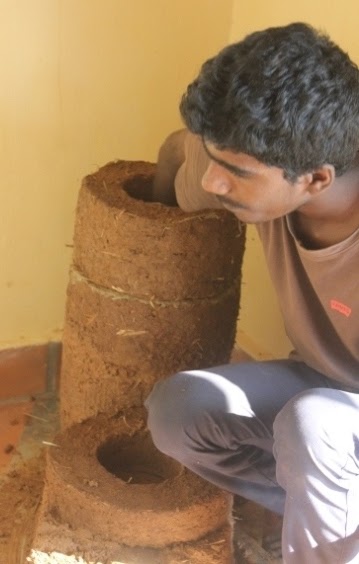
Here he is helping with a rocket stove that we built recently.


Vignesh is out of school and currently enrolled with NIOS (National Institute for Open Schooling) for his Senior Secondary (XII grade) exams. He thus has plenty of time to pursue his interests.

Friday, March 2, 2018

Water Birth


In 2006, when I was a few months pregnant with Aparna, we visited the Birthing Centre in Santa Rosa. It was a cozy little place run by some midwives. There was one doctor on call to perform emergency Ceasareans. Having had a not-so-good experience at the hospital during my first delivery, Dev wanted me to consider this option seriously. I was hesitant because of the expenses involved. Our health insurance was not going to pay for this. After a few weeks of careful contemplation, I decided to deliver at the birthing centre. 

On March 13th, late in the afternoon, my amniotic fluid started leaking. I called Dev at work to update him and started making notes about the happenings. Dev got home in a short while and wanted to make the best use of his time by giving Abhi a haircut! Watching this process turned out to be a good way to labor at home. In about an hour, we were ready to leave. We dropped Abhi off at a friend’s place and headed for the birthing centre.

We reached the centre around 7:30 p.m. I was asked to sit on a rocking chair as one midwife brought a cup of Chamomille tea. It was a cold evening. While I was sipping the hot tea, another midwife brought a pair of warm, rice-stuffed socks to put on my feet. The place was dimly lit and it had a nice calming effect on me. Dev was filling the bath tub with warm water. As soon as it was ready, I got in.  It was as if the warm water took away all my pain. I remember taking some music CD with me and playing it there at the centre. 

As this was a small place, I could easily hear screaming and moaning from the next room.  Two midwives were attending to the lady next door. Around 9 p.m. I remember going on hands-and-knees in the water and feeling the need to push. In just a few pushes, I could feel the baby’s head with my fingers. I urged Dev to get help.  Jennifer came just in time to hold the head that was coming out. It was relatively effortless. Little Aparna was all covered in the amniotic fluid when they wrapped her gently in a towel and handed her to Dev. There was no bath and no soap. 

I got out of the water, dried myself and got dressed. The baby and I were still connected. I got into the bed with the baby next to me. I was still getting feeble contractions. Jennifer reminded me about the last strong contraction that will send the placenta out. No one yanked the placenta; it made its way out naturally. The chord’s pulse was slowly dying down. There was no rush to severe the connection. It probably took an hour for the chord to stop pulsating. That was when it was cut.

At one point, Jennifer noticed that the baby’s temperature had dropped. There was no panic though. Jennifer calmly brought out a warm blanket and asked Dev to take off his shirt. She put the baby to his bare chest and wrapped both of them with the blanket. In about 15 minutes, the baby’s temperature got normalized. She was brought to my breast right away. She was a pro at latching and suckling. 

Abhi came with our friends in the night. He slept there with us and we left the centre as a family of four early next morning. This way of natural birth paved way for a very quick recovery.  As there was no one to help us, I had to start work at home – cooking, cleaning, baby care etc. – from the very first day on wards. The baby’s skin slowly absorbed all the creamy, residual amniotic matter (called “Vernix”) sticking on it. We gave her the first bath after two or three days. During the initial days, when she developed mild redness in eye I was asked to use the breast milk as eye drops. When she had nasal congestion, breast milk worked as nasal drops too! She was a content baby who slept for 22 hours every day for the first six weeks. 

Even now, twelve years later, every time I think of this birthing experience I feel happy and revitalized. Childbirth is a natural process and keeping it that way works wonders both for the mom and the baby. My friends and relatives, who had a spinal anesthesia, either because they couldn't bear the pain or because they had a surgery, still experience side effects of it. It breaks my heart to hear about little babies tucked away in nurseries and ICU’s for very little medical reason.

Here is another water birth experience, from my friend Venetia:
https://svargaonearth.wordpress.com/2018/02/05/birth/