Showing posts with label natural farming. Show all posts

Wednesday, March 11, 2020

Stacking Functions With Trenches

"Stacking Functions" is used in Permaculture to mean that every element in the design performs more than one function. The ideal is to have each element perform as many functions as possible.

One recent example of stacking functions at our farm:

We got some trenches dug for harvesting rain water. Each one was about 30' long, 3' wide and 3' deep. We filled them up with various kinds of bio-mass -- coconut husks, banana trunks, palm shavings, thorny plants, some manure to inoculate the soil with micro-organisms. Adding bio-mass to the trenches increases the absorption of the soil; exposed soil gets parched and can't absorb much rain water.

As we were wondering how we can "stack functions" using these trenches, we discovered three ways of doing so.

1. Growing area for tubers:
Locally grown betel-nut-leaf tuber needs a 3' deep pit, since each one can grow into a whopping 5 kg. Our trenches thus offered the perfect place to grow these tubers. The bio-mass in the trenches were decomposing for three months when we planted the sprouted tubers. They were planted when the monsoon season had just begun, in July. The trenches harvested the monsoon rains, growing these tubers. We had the (aggressive) tuber-vines climb on a make-shift trellis made by erecting huge dead branches. Last week we harvested 12 kg of tubers. It was very gratifying to realize that we never had watered them;  all we did was to plant them at the right time in the right place. This tuber is starchy like any other; it has a more complex flavor than potato. They can be stored up to one year. Local people have taught us a few ways of cooking these. We look forward to growing them again this year.


2. Trellis and Wind Break:
We had put up a make-shift trellis adjoining the rainwater-harvesting-tuber trenches. We wanted to grow some fast-growing trees that would serve this purpose in the years to come and also provide a wind break. We planted Gliricidia sepium to help with both these objectives. The cuttings were thick and fat and at least 4' long. Even though we never watered them, they are thriving beautifully. Thanks to the work done by the trenches. By next season they will be ready to host the betel-nut-tuber vine.

3. Slow-decompostion of thorny trees:
We have a lot of thorny Acacia spp. trees. We started clearing one patch and piled all the thorny branches and trunks into the nearby RWH trench. This mound of thorns piled in the trench is well above ground now. Once the termites take over it will slowly collapse and add fertility to the trench. We will plant trees close to this trench in the next season.

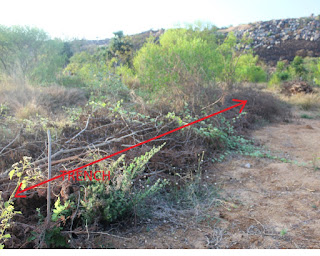


Here I have documented another way of using thorny plants.

- Hema


Friday, January 3, 2020

An Evolving Polyculture

"Burn this ghastly pile of thorny plants". We repeatedly heard this from the local people and farm workers when we had uprooted a lot of thorny shrubs and trees. The pile was about 7' tall and 20' wide. We didn't have the heart to waste that much biomass, much less to produce so much heat and smoke.

"The problem IS the solution" says Bill Mollison, co-founder of Permaculture. With this thought in mind I searched through Mollison's Design Manual. I found the south east Asian design of Palm circles useful and appropriate. Here is how we customized it:

We dug a shallow, circular trench around the thorny pile and mounded the soil (from the trench) on the outer side. We planted 8 coconut saplings around this trench. This formed a circle of 27' diameter. The coconuts were about 10' apart. These were interspersed with banana and papaya. We once grew a small crop of peanuts on the berm. We are now growing pumpkins there.

After three years, this circle and the area around it has become home to all these volunteers:
wild passion flower (creeper covering the thorny pile),
Crotalaria juncea (Indian hemp or sunn hemp),
Clitoria ternatea (creeper with beautiful blue or white flowers),
Crotalaria striata (leguminous shrub with lot of yellow flowers) ,
Calotropis gigantea,
Dodonaea viscosa (shrub),
Holy Basil (Indian Tulsi),
Thai Basil,
Wild Tulsi,
Medicinal herbs,
Rosella (gongura),
Tridax procumbens (ground cover),
lemon grass.

These plants together with the ones we planted (i.e. coconut, banana and papaya) have created a small paradise that attracts a lot of butterflies, birds and bees. The vines keep the thorny pile under a perennial green cover, thus helping with moisture retention and decomposition. Thanks to mainly the indefatigable termites, the colossal thorny pile has shrunk to a mere 2'  mound. A scoop of the soil from underneath the pile now features a beautiful biomass-rich crumb. And all this newly created fertility is slowly oozed out to the plant circle.

A portion of the circle showing Coconut, Bananas and Papaya

The decomposing thorny pile with passion flower smothering it

Aerial view of the circle
According to Bill Mollison, as the coconuts grow the fallen coconut fronds are piled up in the center. This reduces labor when compared to conventional grid-style coconut groves. The pile in the center thus becomes the reservoir of nutrition and moisture. 
The circle is always under mulch with the banana suckers we remove periodically. We once used wasted cardboard to mulch the berm. This brought in a lot of termite activity that enriched the soil.
Initially we flood irrigated the circular trench once in a few days. Now we have laid a drip line. The perennial mulch and drip irrigation put together brings down watering significantly. This circle has gone without water for weeks in a row. The bananas and papayas from this circle are healthy and tasty. We are waiting to see how the coconuts do.


Wednesday, May 22, 2019

In Appreciation Of Coconut Fronds

Coconut fronds are easily available in our area. They have many traditional uses -- broomsticks, roof-base for thatch, fuel in wood-burning stoves. We chanced upon this indigenous material while looking for options for unconventional uses at the farm. This post this about those applications.

To keep the house cool, we wanted to block the heat coming in though the windows that were facing east and west. We thought that the window blinds used on the insides won't be as effective as attempting to block the heat on the outside. Commercial outdoor window shades were expensive and were likely to get worn off after a few rains. We finally decided to use coconut fronds for this purpose. We had a pile of woven coconut fronds (keethu) from a previous project. We just tied a few of them in the following fashion and hung this panel off the roof. This thin layer surprisingly blocked off radiation and kept the rooms cool. Yes, it is a chore to hang up the panels in the mornings and take them off in the evenings. But the gains are quite satisfactory.


We have a circular chicken-mesh enclosure that contains the composting material. Our summer heat was drying up the compost pile and preventing it from decomposing well. We tried wrapping an old cotton fabric; it was working only till we had a gust of heavy wind during which this acted as a sail blowing the entire enclosure away. We had to come up with something else. We then planted coconut fronds all around the pile and tied them to the mesh structure. This is working just fine keeping the moisture content inside the pile intact.
In a span of just a few weeks we get a lot of brown leaves in the village. Many trees shed their leaves around the same time. We wanted to harvest this brown matter that could be used later as mulch or composting material. We wanted an inexpensive place to stock up all this bio-mass. Our farm worker Dhanraj built one for us using coconut fronds. He first made panels with the fronds, then tied the panels to the four posts of the enclosure below. One of four sides of this enclosure is operable.
Panel

Mulch enclosure built with frond panels

I noticed that little tree saplings were struggling to survive in the summer heat (42 deg C). The heat here peaks between 2 and 3 p.m. Blocking the afternoon heat became crucial. I planted coconut fronds in a line to do just the job. Three months into this, I know that these little plants have got over the hump. This flimsy, protective heat barrier is giving way, but it has done its job and at no cost! The mulch in the picture below is coconut frond leaflets discarded after broomsticks are made.


I plan to use light-weight frond tips on trellises to create partial-shade condition below for shade loving plants. The beauty of these fronds is that they are entirely local, mostly discarded and zero-cost. If they cease to offer the protection that we are looking for, they simply become part of the soil; there is no waste.

-- Hema

Tuesday, April 28, 2015

Oh Senna siamea, Thank You!


About a quarter acre of our land is devoid of top soil. Locals told us that the previous land owner had sold the top soil from that patch, about 10 years ago. We used to call that area “the bald patch”. The soil here is heavy clay. In fact we used this subsoil for our earthbag construction project, by excavating a shallow pond.

Every time I was near the bald patch, I felt a pinching pain to see a place so dead as that. Since we didn’t have a water source close by, I couldn’t attempt to green that area. Then came the monsoon rains and the shallow pond was full. In November I transplanted a small Senna siamea plant (hardly ½’) on one of the edges of the bald patch. It was just an experiment.

Senna siamea is a fast growing (leguminous) tree that will grow in a range of climatic conditions but is particularly suited to lowland tropics with a monsoon climate. It belongs to the family of Fabaceae. I was interested in this tree mainly because of the prolific bio-mass that it produces, which can be used as mulch. I had seen these trees grow in uncultivated areas, like along the creek. I didn’t know if it would survive in our bald patch that is quite unlike the creek sides.

The little S. siamea didn’t have much of a shock from the crude transplantation that I did. I was worried if the heavy clay would allow any air exchange to happen. But the plant didn’t seem to care. It started putting out new leaves and I was the happiest person in the world. Some days, during the monsoon, the downpour caused severe erosion. I was worried if the little S. siamea would be able to hold on to its dear life. But the plant had very little problem. It continued growing happily. The monsoon ended in mid-December.

I was watering it for the next two months, manually carrying water from the pond. The S. siamea continued doing well. It in fact put out a new branch! I was jumping in joy. The dry spell started and by mid-February the shallow pond had dried up completely. This meant that I had to carry water and walk for about 5 minutes from the manual (hand) pump, to water this plant. I couldn’t obviously do it as often as I wanted to. So, the next two months was more or less a dry spell for the little plant. But this didn’t abate its growth. I was quite amazed by its resilience but was also concerned about the upcoming summer heat for the plant.

Fortunately, this month we had about 15 cm. of summer rain. The S. siamea continues to thrive and is now a handsome 3’ tall young tree. Watching this plant’s growth has been a phenomenal spiritual learning experience for me. It was as if the plant was speaking to me, saying:

“No top soil?
Not a problem. Here I will toil.

Heavy clay?
That is okay.

Roots get very little air?
I don’t care.

Soil erosion?
Tightly I will hold on.

Too much rain?
I just am fine.

Too little water?
Can’t deter (me).

I continue to be happy as can be.”

Thank you, my dear little S. siamea. I will remember this during difficult times.

-- Hema

Wednesday, November 21, 2012

Raju Titus interview Part 1


To my knowledge no one in India -- perhaps even in the world -- has pursued Masanobu Fukuoka's vision of Natural Farming (NF) with such single minded devotion and for so long as Raju Titus. Raju-ji and his wife Shalini-ji started on their NF journey about 27 years ago on their 13 acre farm in Hoshangabad, MP. Over the years they have allowed Nature to tell them what to do with their land -- and indeed to influence all aspects of their lives. But that is getting ahead of the story that we want Raju-ji to tell us instead.


Recently we spent two days at their farm. We talked NF, made seed-balls, prepared a small patch of land for seeding and not least, ate delicious rotis made from their naturally grown wheat. We also got a taste of Raju-ji's enthusiasm for connecting with local farmers for no other gain than to spread a good idea. Raju-ji took us on two excursions to nearby villages where he shared his NF experience with local farmers (see pictures).


After we got back, we met people curious about Raju-ji and NF, and also had a growing list of our own questions. This gave birth to the idea of doing an offline interview with him for wider circulation and Raju-ji readily complied to our request for one. Part 1 of the interview is posted below in the translated version. Here Raju-ji talks a bit about the history of his farm, a little about what to do in NF, and more importantly, in keeping with the spirit of Fukuoka's Do-Nothing philosophy, what not to do


The original Hindi version is a separate post. 


Raju-ji, Shalini-ji with granddaughter


Q: Before you came to Natural Farming 27 years ago, what kind of farming were you engaged in? What were you growing?

RT: Before starting on NF, I was doing the "Green Revolution" style of farming with deep tilling, chemical fertilizers, pesticides, herbicides, hybrid seeds, heavy irrigation and leveling of fields. I was growing soya and wheat. I did this for 15 years. Before that I was engaged in local, indigenous style of farming but then got caught in the cycle of wanting more.

Q: In our conversations you had said you were on the brink of giving up farming altogether. What were the reasons for that? What specific difficulties were you facing?

RT : During the "Green Revolution" years, I got my fields leveled, hired people to get rid of "Kans" grass [a difficult weed], got a well dug for irrigation purposes -- electric pump and all -- and made use of rented tractors. Essentially, whatever the Agricultural Scientists advised, I did. For the first year of doing all this I got good results but never after that. I kept at it for 15 years, and during this time my fields were turning into deserts and I was heading towards bankruptcy. My land was filling up with Kans grass, indicating desertification of the soil.  With this grass in the soil, the expenses increase but yields go down.

Mounting financial difficulties forced me to resolve to giving up farming altogether. I had a job at that time to lean on, otherwise I would have ended up like many farmers of today. My parents had 4 plots of lands in the city -- even these were sacrificed towards the farm.

Q: How did you learn about NF? After discovering NF what kind of changes did you make in your farm?

RT : My decision to quit farming had particularly saddened my parents.  Right around that time they came in contact with the Gandhian Quakers, Marjorie Sykes and Partap Aggarwal. They had just brought out the first Indian edition of One Straw Revolution and handed a copy to my mother. I read the book at my mother's behest, and I was converted.

I adopted NF right away. Now, this had the effect of causing great alarm to my parents, Marjorie-behan and Partap-ji because they were concerned that any failures would bring bad name to NF. What followed was without any pre-meditated design. My factory job came in useful: while I had wanted to quit it, it was instrumental in keeping my mind off matters of making an income.

In the beginning, all I knew was that in NF tilling, fertilizer and chemicals were unnecessary. But I did not know how to go about it. One time, during the rainy season, I spread some soya-bean seeds on the ground and covered them with straw. A few days later I saw little soya-bean plants peeking out of the straw
and not one weed. I was overjoyed and started to farm in this manner. Instead of the straw, I would cover the seeds with Kans grass cuttings. This not only  gave me a yield, it also started defeating this most difficult weed. Incidentally this experiment also impressed Fukuoka-ji during his January 1988 visit to my farm -- he declared it to be the best NF experiment in the world.


Q: From our talks, I know that Shalini-ji has been your great collaborator. For one, I greatly enjoyed listening to her description of how she would go manually broadcasting seeds over several acres, and they would fall evenly. Tell us about her role.

RJ : Without my wife's support nothing would have been possible. She has been my real partner in farming. In NF there comes a time when your wife is your only support. In NF, there are many tasks -- getting the fields readied, broadcasting seeds, irrigation, harvesting and threshing -- and she is a key contributor in each of these. We consult together whenever there is a new experiment to be carried out. Because of NF, our family has been able to be happy despite facing many difficulties. This kind farming does not just provide us with food and water, but also brings the family closer.

Raju-ji explains NF to farmers near Hoshangabad
Later, Raju-ji surveys a chemically farmed field for changing over to NF

Q: Today, a lot of farm lands in India have become wasted -- not a blade of grass seems to grow on these. Starting NF in this kind of fields is difficult and people that try it soon give up and turn to tilling. What has been your experience?


RT: My land had become lifeless due to my own mistakes. When Fukuoka-ji saw me farming with Kans grass, he was delighted. He had just returned from his America trip and had said that this kind of grass had become rampant in the US and where it had spread, farming had been stopped. He said that they (the American farmers) don't know how to deal with this and here you are doing NF in the presence of this very grass.

In this region, on Rishi Panchami [a local festival] day, people still perform pooja of Kans grass and consume natural food grains. If this grass appears in the fields, farmers are advised to stop plowing the land. In the indigenous method of farming, people would follow this practice and then the grass would naturally disappear and the fields would return to fertility.


No-till NF is a method to restore fertility to the fields. In Nature there is no land where absolutely nothing grows. Something or the other grows even in water, in sand, and on stones; all we have to do is to help Nature along.


Q: So how does one "help Nature along" on a barren piece of land?


RT : When I had started on NF, I had no idea what to do. Basically I understood what not to do, like tilling, preparing compost, using chemicals and grazing etc. So first I got rid of the animals, then paid attention to the fencing. I completely stopped any kind of harm caused by outsiders or insiders. By merely these actions, my fields were filled with green cover at the end of a single rainy season. I felt as if Mother Nature, who had lost all vigor through sickness, had come back to life. Lush-green grass, countless trees and shrubs, animals, insects, butterflies and bees started to come back. Then people started to come to see this transformation. All this gave me deep satisfaction. Because my inputs were now minimal, financial losses also stopped. Over time, native Babool (Acacia nilotica), Subabool (Leucaena leucocephala) and other trees started flourishing there. And then I started throwing seeds following Nature's example.


Really, Nature does not need our help; what it needs is protection. Humans and farm animals cause maximum damage and all you have to do to help Nature is to stop this damage. Even complete wastelands can be restored by this technique. Just get rid of the forces of destruction and multitudes of life forms start working on their own. There is no need for applying great human intelligence.