Saturday, June 8, 2019

"Can you speak Math?'


Isn’t English just another language? Apparently not, in these parts of rural India.

The other day, Aparna and I spotted some country chickens by the roadside and stopped to buy free-range eggs. Sheela, a nine year old girl stepped out as we got in front of her house. I asked her for eggs, in Tamil.  Aparna asked me something in English, to make a point discreetly. I took my cue from her and replied briefly in English. When I turned back to Sheela I found her awe-struck. She was curious to know about the sounds that she just heard. I told her that we spoke in English. The expression on her face changed instantaneously; she was lost in thoughts and was not paying any attention to my translation.   

Suddenly she burst out, “Can you speak Math?” I was caught unaware. I didn’t understand the depth of her question. I simply said “No, I can’t speak Math”. Later that day when I had the time to mull over Sheela’s question I understood what she actually meant:
Here, the school syllabus consists of five courses or subjects viz. Tamil, English, Math, History-Geography and Science. Thus in Sheela’s mind, if I could speak Tamil and English I could possibly speak the next subject, Math, too.

Once I understood the profoundness of her question, I couldn’t just brush it aside as an innocuous one. I was seething with rage for this child. My mind was racing with thoughts such as:
What does this education mean to a child like her? Is it just a bunch of trivia that she has to know to pass some meaningless exams? This education has nothing to do with her real life, but yet she has to endure it for at least fourteen long years. She has to “learn” these subjects that absolutely no one around her seems to be knowing anything about. Above all, she is in the least bit interested in this “education” that has subsumed her childhood.

In this context, I would like to share this documentary on Schooling:
Schooling The World                                                               -

---

I went to Kumar’s place in a nearby village to get some saplings. Kumar is in his forties. He owns a few acres of ancestral farm land. He lives with his elderly parents, wife and two children. The people of this village are mostly affluent and influential.

I have run into Kumar several times before and he had always tried hard to talk in English with me. Those were awkward moments for me to see him struggle to communicate in English while both of us could have conveniently and meaningfully conversed in Tamil. Kumar’s native language is Telugu. But he can speak fluent Tamil and switch between the two languages effortlessly.

He and his wife greeted me in when I got to his place. His wife is bilingual too. We were chatting over snacks and a drink of water. In just a few minutes, he asked me about my children’s education. He knew that they didn’t go to school. Before I could begin to reply, he interjected by saying, “your children must be smart and that’s why you are able to do this.”

I have heard this comment from so many people; but still it hurts me every time I hear it. So, I got started on many topics under the umbrella of education. I asked them both questions about their times at school and shared my radical views with them. I talked non-stop, in Tamil, for several minutes. I don’t know how much of what I said made sense to them. But something remarkable happened after I stopped. 

Kumar started to talk and this time he talked in Tamil. “My father is good at English. He worked for the British. But I never learned the language well. I had disappointed him. Now my son goes to an English medium school and my father expects him to learn good English.”

His facade was crumbling and he didn’t seem to care.

-- Hema

Wednesday, May 22, 2019

In Appreciation Of Coconut Fronds

Coconut fronds are easily available in our area. They have many traditional uses -- broomsticks, roof-base for thatch, fuel in wood-burning stoves. We chanced upon this indigenous material while looking for options for unconventional uses at the farm. This post this about those applications.

To keep the house cool, we wanted to block the heat coming in though the windows that were facing east and west. We thought that the window blinds used on the insides won't be as effective as attempting to block the heat on the outside. Commercial outdoor window shades were expensive and were likely to get worn off after a few rains. We finally decided to use coconut fronds for this purpose. We had a pile of woven coconut fronds (keethu) from a previous project. We just tied a few of them in the following fashion and hung this panel off the roof. This thin layer surprisingly blocked off radiation and kept the rooms cool. Yes, it is a chore to hang up the panels in the mornings and take them off in the evenings. But the gains are quite satisfactory.


We have a circular chicken-mesh enclosure that contains the composting material. Our summer heat was drying up the compost pile and preventing it from decomposing well. We tried wrapping an old cotton fabric; it was working only till we had a gust of heavy wind during which this acted as a sail blowing the entire enclosure away. We had to come up with something else. We then planted coconut fronds all around the pile and tied them to the mesh structure. This is working just fine keeping the moisture content inside the pile intact.
In a span of just a few weeks we get a lot of brown leaves in the village. Many trees shed their leaves around the same time. We wanted to harvest this brown matter that could be used later as mulch or composting material. We wanted an inexpensive place to stock up all this bio-mass. Our farm worker Dhanraj built one for us using coconut fronds. He first made panels with the fronds, then tied the panels to the four posts of the enclosure below. One of four sides of this enclosure is operable.
Panel

Mulch enclosure built with frond panels

I noticed that little tree saplings were struggling to survive in the summer heat (42 deg C). The heat here peaks between 2 and 3 p.m. Blocking the afternoon heat became crucial. I planted coconut fronds in a line to do just the job. Three months into this, I know that these little plants have got over the hump. This flimsy, protective heat barrier is giving way, but it has done its job and at no cost! The mulch in the picture below is coconut frond leaflets discarded after broomsticks are made.


I plan to use light-weight frond tips on trellises to create partial-shade condition below for shade loving plants. The beauty of these fronds is that they are entirely local, mostly discarded and zero-cost. If they cease to offer the protection that we are looking for, they simply become part of the soil; there is no waste.

-- Hema

Friday, May 3, 2019

Pleasantries To Fake Cordiality

Raj(16) goes to a Government school in our village where the medium of education is Tamil, which is the local language and his mother tongue.  All his school books are in Tamil, except of course the English book. One day he came to me asking for help with an English poem in his school book. It was titled "Once upon a time'.   This poem was written by a Nigerian poet called Gabriel Okara. Here the poet laments about our fast-changing society which is losing its values. He admits conforming to the new fake ways of interacting with others. He pleads with his son to teach him to be authentic and live like a child again.
***

Once Upon A Time
Once upon a time, son,
they used to laugh with their hearts
and laugh with their eyes:
but now they only laugh with their teeth,
while their ice-block-cold eyes
search behind my shadow.

There was a time indeed
they used to shake hands with their hearts:
but that’s gone, son.
Now they shake hands without hearts
while their left hands search
my empty pockets.

‘Feel at home!’ ‘Come again’:
they say, and when I come
again and feel
at home, once, twice,
there will be no thrice-
for then I find doors shut on me.

So I have learned many things, son.
I have learned to wear many faces
like dresses – homeface,
officeface, streetface, hostface,
cocktailface, with all their conforming smiles
like a fixed portrait smile.

And I have learned too
to laugh with only my teeth
and shake hands without my heart.
I have also learned to say,’Goodbye’,
when I mean ‘Good-riddance’:
to say ‘Glad to meet you’,
without being glad; and to say ‘It’s been
nice talking to you’, after being bored.

But believe me, son.
I want to be what I used to be
when I was like you. I want
to unlearn all these muting things.
Most of all, I want to relearn
how to laugh, for my laugh in the mirror
shows only my teeth like a snake’s bare fangs!

So show me, son,
how to laugh; show me how
I used to laugh and smile
once upon a time when I was like you.

 ***
In Raj's book, at the end of this poem there is a list of questions for the students. One of them is:
"What pleasantries does the poet use to fake cordiality?"

When I read this for the first time, I faltered when I encountered "pleasantries".  Honestly, that was the very first time I had encountered this word. Although I guessed its meaning based on the context, I didn't know what it exactly meant until I looked up online. To any non-English speaking student, who goes to a non-English medium school these English words are as alien as Chinese or Greek. I know that these children here have never come across these words ever before in their lives.

Now, what are the chances of a teacher in a Tamil medium school knowing all the words in this question? Let us assume that the teacher came prepared to school to "teach" this poem, for there is a glossary at the end of the poem. But there is no way of getting the answer right since there is no glossary for the questions themselves! Ultimately this question gets ignored by everyone including the teacher. Such questions are not so innocuous though. I think they have the potential to sow the seeds of inadequacy in the reader.

The poem itself is in simple, non-intimidating language. Ironically the question is not. Even if the reader could understand and appreciate the poem, this question is capable of shaking that understanding. It makes me wonder what the agenda of  this "education" is.

-- Hema

Saturday, March 2, 2019

Turtle Walk

After getting to Chennai last week, we geared up very excitedly to walk the Neelankarai beach. We were going to participate in a turtle walk organized by a student group called the Students' Sea  Turtle Conservation Network (SSTCN). It is a voluntary group working on the beaches of Chennai since 1987, trying to conserve and create awareness about the endangered Olive Ridley sea turtle.

We had a cup of tea at 10:30 p.m. hoping earnestly that it will help us stay awake all night. When we reached the beach we were happy to find a lot of young people there for the walk. Since there were about fifty of us, the volunteers split us in to two smaller groups and started their introductory talk. One of the things they said that I found astonishing was that turtles have been around for 120 million years! They have been around since when dinosaurs were here on the planet! These creatures must be masters at adapting to the changes in their environment. And yet for the last three decades, this student network  has been trying to conserve the sea turtles. How did these incredible survivors, in the long history of evolution, get to the brink of extinction?

Over the course of the introductory talk, we learned about the unfortunate situation of these sea turtles. The female turtles lay their eggs in sub-surface nests on oceanic beaches. When these eggs hatch, the hatchlings move in the direction of the brightest light in their quest to find the sea. Until  modern times this was light of celestial bodies reflected off the sea. Now, without conservation efforts, the hatchlings would walk away from the sea towards bright human settlements, only to perish soon after beginning their lives. Our well lit "safe" beaches are quite unsafe for these ancient beings. 

When I looked up the internet on this subject, I found these images released by NASA that indicate a significant increase in India's night lights. The latest image below is of 2016's:

India''s Night Lights - 2016
Now compare this to that of 2012.

India's Night Lights - 2012
If you are curious about the global picture, here it is.


Light pollution or losing the dark is a serious, pressing problem and probably the least talked about of pollution issues. This is a relatively new phenomenon, just decades old in India. Animals (including humans), birds, insects, indeed most of life hasn't evolved to deal with light after sunset. And for some, like the turtles, it is a matter of life or death, of survival or extinction. Here is some good information about light pollution.

Back to the Turtle Walk.

We started the walk after midnight. A group of people from the forest department (!) had set out an hour earlier to scout for a fresh nest. Not all walks come upon a nest, but we hoped ours will. In the meanwhile we found a big Olive Ridley female. Washed ashore dead, thanks to trawling. I touched her shell, wondering how a creature encased in such impregnable armour was still so vulnerable to human activity.  This morbid find had affected the group's spirits and it weighed on us for the next half hour. 

This changed when we saw a signal from the forest scouts. We rushed to the spot where the scouts had located a potential nest. This called for some hand digging, which a volunteer started carefully. He said that these sub-surface nests have a short narrow neck and a round cavity underneath. Once he got to the cavity, he gingerly scooped out a white object, the size of a ping-pong ball and passed it to the group. It was warm to touch, the shell still not hardened. Likely laid less than a hour ago! The volunteer kept reaching in and bringing out more eggs while we were counting and bagging these precious little parcels. After a ten minute operation, we had 124 eggs in our bag! One hundred and twenty four! How did that mother manage to walk up the beach with so many eggs, dig out a beautiful nest, lay them all and then finally clean up the site to not leave a trace?  Truly magical.

We took a break around three in the morning. It was absolutely wonderful to lay down on the beach and doze off while listening to the waves. We woke up refreshed and ready for the last leg of the adventure. When we continued our walk, the conversation got around to eco-systems, their fragility and the fast rate at which they are disappearing due to Climate Change. Many of us walked in silence while digesting these hard realities. After an hour-long walk, the eggs were taken to a hatchery. There are many hatcheries on this beach between Neelankarai and Adyar. These are simple enclosures built with bamboo posts and woven coconut fronds. The eggs will hatch here in about two months and the hatchlings will be released into the sea.


-- Hema

Saturday, February 2, 2019

Meeting Expectations

Very often I see parents who talk about their kids, in their presence, quite oblivious of what impact such talk might have on them. I address this aspect of parental behavior here in this post. The idea of this exercise is to look at such talk from the perspective of a child who is listening to her parents' remarks about her. To a lot of parents the contents of this post would be obvious, so this is clearly not directed towards them.

Incident 1: A dad came in with his five year old wanting to discuss homeschooling. He said things like "my son is just five, but knows the English alphabet already", "He is a fast learner", "His learning is just amazing"r, "He is very naughty.  He will take up all your time, you have to constantly monitor him".
*
Incident 2: The parents of these two little girls were interested in talking about farming and global issues. When we got around to talking, the girls found their way to the piano that was in the living room. I was going to tell the little ones to make sure they played it softly to allow us to talk, but the mom pre-empted me with a smile and helpless voice, saying "Oh! once they start playing they won't stop and also it would be so loud that we can't talk".
*
Incident 3: This mom came with her three year old who gets to see her dad only during the weekends. During one of the conversations the mom, with the child right next to her, said to me "She really misses her dad. She often wishes her dad could be there to play with her".
*
Incident 4: When a city-dwelling family with an eight year old boy was visiting us, I suggested to my kids to take their new friend to get milk from our milk lady. The walk was hardly 100 meters. They had to cross a not-so-busy village road.  The mom immediately intervened saying, "Oh, my son shouldn't go. He doesn't know how to walk on roads. He will hurt himself in the traffic." Having observed this eight year old for a day, I didn't think that the mom's statement was true. Nevertheless we dropped the idea.
*
Incident 5: A three year old that visited us was having a very good time playing here. When it was time for him and family to leave, the mom said (right where the child was playing), in an exasperated manner "now comes the difficult part. He wouldn't quit playing and won't get ready to leave" .


Observant parents know that children are tuned in to their parents' conversations whenever they are in earshot. This happens regardless of whether the kids are seemingly engrossed in other activities. Now I want to revisit each of the above examples and look at them from the concerned child's perspective. Although we don't of course know what the child is actually thinking, it is still worth looking at about what the child might be thinking.

Incident 1: This five year old may now think, "My dad thinks I am very smart. I got to be smart. I learned the English alphabet so quickly". Now if, in future, this child wants to learn something and he can't learn it quickly then he may have a contradiction in his mind, since his dad had already declared him to be a fast learner. Would he, at that point, decide to pursue his learning and modify his identity from being a "fast learner" to a being "slow learner" and continue his learning? Or would he give up learning that particular skill that is challenging his given identity as a "fast learner"?  Regarding his "naughtiness", the child senses the implicit giving up of parental authority in his dad's voice and has no reason to modify his (mis)behavior.
*
Incident 2: When the little girls heard their mom say "once they start they won't stop and also it would be so loud that we can't talk", at least I wasn't surprised that they followed through meeting the mom's expectation.
*
Incident 3: It is possible that the child missed her dad. But often when little kids are having fun, they tend to to live in the present moment. They are not thinking about other things. Was it instead the mom who missed her husband? When I brought this up later with the mom, she admitted that she missed her husband during the week and possibly projected that feeling on to the child. So now,  was the child carrying a feeling that wasn't necessarily a felt experience for her?
*
Incident 4: If this is something the eight year old hears often, at least some part of him would have to deal with his non-existent inability to walk on the roads.
*
Incident 5: Again here, from the child's perspective, the mom has verbally given up her parental authority. Would the child then feel the need to comply to the mom's request?

Once we start paying close attention, there are countless examples like these. The potential danger in these cases is that the kids' identities are created by the adults around them. Can we let the children form their self-identities on their own, based on their own experiences over an extended period of time?
-- Hema

Wednesday, January 30, 2019

Windows

Modern windows and their construction, both in India and the US, have bothered me quite a bit for the following reasons:

- Window sills, whenever they exist, are on the outside of the building. These sills are rendered useless, collecting dust and debris.
- The placement and height of the windows ensured that we stared at the walls when we sat on the floor and never could enjoy the view, defeating the very purpose of having those windows there.  Since we preferred floor seating, this issue was nagging me constantly.
- Elaborate window grills are maintenance nightmares.
- Windows with glass panes let in heat even when they are closed.
- Window panes are too big; there is no way to open small portions.
- Windows that are flush with the wall seemed to me like incomplete construction.

So I decided to understand windows very well, before we started our house construction.

Our architect Mr. Sudhir, founder of Peoples Architecture Commonweal (www.commonweal.in), specializes in vernacular architecture. He insisted on us visiting many local traditional houses and gaining understanding on how and why things were done the way they were.

On close observation, I realized that the windows in old, traditional style houses in our village differed quite a bit from the ones in new houses and also had addressed many of my concerns. I wrote about these houses here:

With aesthetics and utility in mind, I started fervently reading Christopher Alexander’s book “A Pattern Language” and found it to be a great resource in designing our house. Here I illustrate the features of our house that are in line with the patterns in this book.

Most of our windows are 18” from the floor. They are all used; procured from building demolition sites. All our windows have four panes; two top panes and two bottom ones (pattern 239-Small Panes). The panes are solid wood. In some windows, the small non-operable part at the top is glass. Our walls are 15” thick; 50% thicker than normal brick walls (pattern 197-Thick Walls, pattern 223-Deep Reveals). This is because of the outer skin of burnt bricks that is covering the inner adobe bricks. The thickness of the walls  provides ample sill space. In some places we have extended this sill space to achieve window seating (pattern 202-Built-in Seats). Christopher Alexander says:  "windows that create “places” next to them are not simply luxurious, they are necessary" (pattern 180-Window Places).

A built-in bench by the window in the living area

A built-in bench by the window, connecting kitchen and dining spaces

A built-in window seat

This built-in bench merges with the window sill

Kitchen Window

The kitchen window sill merges with the counter


From Christopher Alexander’s book, I learned that not all windows have to be of the same size. Also, in some places it is not appropriate to have big windows. This was the case in our corridor connecting the two rooms. We have a small window here offering a glimpse of the easterly view,  as in pattern 134-Zen View. 


I enjoy these window places so very much.

-- Hema

Friday, January 18, 2019

Vignesh

In this post I will showcase the work of a talented 15 year old friend of ours. Vignesh came to me last year to learn English. Like the other kids in our rural neighbourhood he was shy in the beginning, but unlike them he was also thoughtful and sensitive. Over time we found out he was good at sketching, painting, clay modelling, and cooking, largely self-taught. Once in a while he brought some of his creations to my “English class”. I was pleasantly surprised at the quality of his clay pieces despite the rough material involved. The material used in all the pieces shown is just unfiltered clay harvested from a local pond.

The following two pictures are of Vignesh’s self-portrait.


During the course of our English classes I got to know him better. He told me that since he was in X grade he was being forced to go for private tuition, both before and after school hours. Thus he hardly had any time for himself. He expressed his oppressive situation in the sculpture below, which shows two school children with wings attached but begging for freedom to fly.


Children enjoying each other’s company.


For Ganesh Chaturthi, Vignesh’s Ganesha falls prey to the modern lifestyle.


A more conventional Saraswati for Navratri.


More deities for the local festivals.


Once when the squirrel foundling that Abhi and Aparna were raising suddenly died, Vignesh made this clay squirrel below to help them deal with the loss.


Since we found his talent exceptional, we made arrangements for him to host a few sessions in Chennai where Vignesh got to share his clay modelling skills.


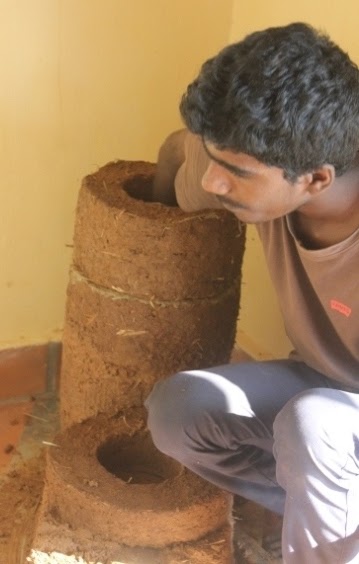
Here he is helping with a rocket stove that we built recently.


Vignesh is out of school and currently enrolled with NIOS (National Institute for Open Schooling) for his Senior Secondary (XII grade) exams. He thus has plenty of time to pursue his interests.