Tuesday, December 26, 2017

"The Risks Of Rewards"


My parents didn’t believe in rewards and punishments. Their parenting style didn’t include both these “techniques”. They treated achievers and non-achievers (in academics) alike. My dad’s focus was on making sure his children were happy at the end of the day. At home, there was transparency in all matters. Our parents trusted us (three daughters), and we (unknowingly) never misused that trust. Our neighbours’ practices were exactly the opposite. This was back in the 70’s and 80’s, when growing up in Trichy in South India.

Thirty years later, I had my children when we were living in California. Any trip to the neighbourhood park or the playschool or a grocery store or a birthday party was an assault on my understanding about parenting. Every few seconds I got to hear some parent or the other saying “good job” and I cringed every time I heard that.  They were good-jobbing every move of the child. I noticed that good-jobbed kids were not entirely free and they were constantly checking what their parents’ reaction to their behaviour was.  My initial response to this was “THIS IS NOT RIGHT”.

But then, I was in a foreign land and I couldn’t clearly articulate what was wrong. Soon after Abhi had started kindergarten, he became defiant. After a long period of confusion and conflict, I succumbed to the techniques of good-job, 1-2-3, star charts, time-outs etc. Like with any other band-aid solutions, the effect of these techniques was temporary. Dev was urging me to take a deeper look at the issues at hand. Fortunately, around this time, I chanced upon Alfie Kohn’s “Unconditional Parenting” at a friend’s place. She was then into “The Magic of 1-2-3”. She gifted me Kohn’s book since she found no use for it.

I fervently read the book, cover to cover. Dev and I watched some of Kohn's speeches on youtube. His critical outlook appealed to me right away. It helped me reconnect with the parenting style that I was once used to.  All of a sudden, things just dawned on me. Basically, rewards and punishments are two sides of the same coin. Both are behaviour-manipulating tools. And it didn’t feel right to manipulate the behaviour of kids to suit our purpose. Also, the joy of learning or doing something is taken away by praising the learner/doer who ends up learning/doing things JUST to win rewards from us. It was painful to acknowledge the mistakes I had made and the damage I had inflicted on my kids. But it had to be done before it was too late.

Since I had received unconditional parenting myself, I found it natural to latch on to it and be the giver this time. There have certainly been hiccups. But, I have stayed on this track which has helped us cultivate and enjoy a beautiful, trusting, joyous relationship.

There are many speeches oh Kohn on youtube. These are some of his insightful articles:


Thursday, December 21, 2017

When Beauty Gives Way


Every time I pass by the old streets of Athimanjeri, I can’t help envying the residents there. Irrespective of the time of the day, people are out of their houses, having a good social time. Mostly they are weavers working on power looms installed in their houses. 


These houses are 70 - 100 years old, built with stones and mud. The pitched roof is made of palm (or teak, occasionally) rafters and country wood purlins. Curved clay tiles, aka “pan” tiles, are arranged closely on top of the timber framework. This roof thus provides countless vents for the hot air inside the house to escape, keeping the house naturally cool. WYSIWYG – you can see what these houses are made of. Laurie Baker called this kind of construction “honest”. 


These traditional houses follow a certain pattern that has evolved to suit their profession -- thin, long wall to wall houses with a street-facing sheltered sitting area (called “thinnai”), a big room housing the loom, an open courtyard with water storage facility, a kitchen over-looking the courtyard followed by one or two rooms at the back. At the very end of plot there are some trees or plants.


The thinnai is basically a bench, broad enough to accommodate a person who needs to sleep there. In olden days when people used to travel on foot, thinnai offered just what a tired traveler was looking for. Sometimes, the travelers were fed by the house owners, but they would never charge anyone for using the thinnai. During the day, the thinnai offered a space for women to process food together (clean grains, deseed tamarind) and for children to play. Pretty much all thinnai have occupants in the afternoon hours enjoying their afternoon naps. Some thinnai have a dice game (like ludo) painted on the sitting surface. Dice games are old people’s favourite. Thinnai welcomes animals too; I have seen goats and dogs enjoy this space on very hot afternoons or rainy evenings. Thus for ages, thinnai has been an essential element in the social fabric here but it fast getting obliterated.

As people started getting richer, they wanted to build “modern” houses with burnt-bricks, cement, steel and tiles. Without understanding the patterns that their old houses were built on, they demolished them and built boxes that turned beautiful, lively streets into dead streets lined with high-raised walls. The modern construction involves building brick walls with cement mortar, plastering the walls (inside & outside) with cement mortar and laying RCC slabs for the roof. This construction leaves no outlet for heat to escape the house. In the recent years, people here have started pasting tiles on plastered walls. I have seen tiled walls inside the houses too (not just in bathrooms and toilets). Thus there are layers and layers of material, one hiding another, leaving honesty that once existed, way behind. 

On the right is a newly constructed house with tiled facade


Multistorey vitrified tiled facade and high gates looming over the modest next door

These modern houses lack aesthetics, cost a lot and are uncomfortable for the residents. So, why do they construct these houses?

When we were procuring old roof tiles for the construction of our house, we got our answers to this question. “We are just following the crowd, like goats do”, said a man remembering his old house sadly and hanging his head low. “People don’t respect the families living in indigenous houses and won’t marry in to those families”, said another. “We fell for the flashy looks of the new kind and no one told us that our new modern house will be hotter than the old tiled house”.

-- Hema

Tuesday, December 19, 2017

House Construction

Here are some pictures from our house construction:

Applying cashew-shell oil on the wooden surfaces that would come in contact with the mud walls

Fixing the adobe-brick walls after the damage caused by rains
Curing the bathroom burnt-brick wall with cement mortar


Applying a natural finish (fermented mix of cow dung and sieved soil) on mud plastered wall


Our neighbour appreciating the naturally finished wall

White washing the naturally finished wall
The team of masons that laid the floor tiles (terracotta) abandoned the project half-way through. We decided to take it up and have been grouting for the last few days:


Sunday, December 17, 2017

Cardboard Creations

It started out as a doll game, three years ago. We had a family from Hyderabad move here into the village, for a brief period. Their two kids and ours started playing with dolls. This involved making clothes and building spaces for their dolls. They created partitions in a shelf to accommodate a doll-house. The next few weeks went into making miniature furniture, appliances and electronic gadgets. They used cardboard, glue, sticky tape and a pair of scissors. Some of their creations had to go through several iterations (ex. tables) before they were deemed perfect for their dolls. A few months later the Hyderabad friends moved back to their city and there was a lull in the doll game.

In the meanwhile, the kids’ interest in Legos took over. Once a big chunk of their Lego collection got stolen and they were heart-broken for several days. While we were wondering if it would be prudent of us to buy some new Legos, they started using their cardboard skills in making things that were Lego-compatible. Over time this game evolved into a complex one, mimicking real life scenarios and places. 

As their skills were getting better, they started seeing cardboard as a medium to express themselves. To compensate for the lost Lego cars and trucks, they built moving miniature models. When they needed to churn out models quickly in big numbers, like in the case of soldiers, they figured out templates and how handy they were.

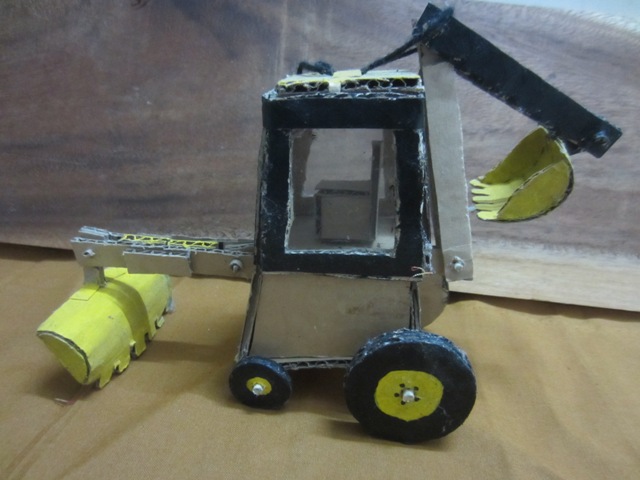
Here are some pictures from the kids' cardboard collection:
 
Cardboard Pendants

Helmet with a visor

Inspired by Kathakali

The making of Star Wars' Kylo Ren's helmet:


It took them several passes to get the wheels and spindles to work. Dried thick stalks of lemon grass were used as axle rods.
Merry-go-round

Earth mover

Star Wars' Tie Fighter

Soldiers and an army jeep
2.5" tall car
Handicraft collection


Carcharodontosaurus, with operable mouth and forelimbs
These have seen weeks of hard work, motivation, frustration, perseverance, tears and commitment. The end result has mostly been deeply satisfactory for them. Each one of the projects that they took up was born out of necessity (for the game that they were playing then) or interest. Dev and I had very little to do with any of these.

Observing this self-learning process has been wonderful.  I realized that learning is fun and exciting when initiated by the learner.I think it is an empowering experience for a child to see a project through all its phases, from conception to execution, without any unsolicited input from others.

-- Hema


Thursday, November 23, 2017

Morning Till Evening (Part IV): Time Restricted Feeding


According to U.S. National Center for Biotechnology Information (NCBI),
“Time-restricted feeding is a daily eating pattern in which all nutrient intake occurs within a few hours (usually ≤12h) everyday, with no overt attempt to alter nutrient quality or quantity. The concept of TRF arose within the context of circadian rhythms.”

Since a few years, we have been battling a lot of health issues and trying to gain better understanding of health. Our kids have been having tummy issues and we were not getting anywhere with Ayurveda or the periodic purges that western medicine practices. Dev has had a “leaky gut” for long. His reading and research introduced us to Dave Mayo’s program on TRF and retraining circadian clock. We have been following this program for the past four months.

Basically, the idea is to eat well, very well, during the day (between 8 a.m. and 6 p.m.) and not eat anything before or after this window; also it is equally important to eat ONLY during meal times and not in-between.  Mealtimes are driven by hunger and not clocks. Here, I will outline the changes we have made in the recent months: 

About an hour after waking up, we have our coffee/tea and follow it with breakfast (in 20-30 min). We have a substantial (vegetarian) breakfast with a good amount of protein and fat. We use coconut oil and sometimes ghee to increase the fat content in our meals. For the next four hours we don’t eat or drink anything other than water. We are typically outdoors after breakfast. 

Lunch is around noon. This is also a heavy vegetarian meal, with good amounts carbs, protein and fat. Post-lunch is indoor time. The next four hours is a break for the tummy; nothing goes in except water.

Dinner is around 5:30. This last meal is very light; sometimes I skip it. Thus the body gets a break from food for about 14 hours (till 8 a.m. next morning).  If we feel like tea or snacks or fruit, we have it either before or after meals (within a 20-30 minute window). Kids follow the same eating pattern.

Now, this is all based on modern research and understanding but it is totally compatible with how poor and lower middle class villagers live. Life during the pre-electricity years was also TRF-compliant. I remember stories of my parents’ childhood (from 60 years ago). It was imperative then to finish the last meal before sunset and almost impossible to start the fire in-between meals for snacks. Also, the luxury of snacking never existed in the evolution of mankind.

Before the TRF program, our family was the only one that was into snacking in the village. We used to eat fruit or have tea/milk in-between two meals. In a way, we were resetting our digestive clocks every couple of hours or so. The rest of the people here never snack; they simply can’t afford to. They are healthy people though, raising healthy children in spite of the poor quality food that they eat. This had caused me a lot of confusions for very long, because of the American culture of (healthy) snacking that we got exposed to. Now with the new understanding of TRF, it all makes sense.

The benefits of the fasting period, between 6 p.m. and 8 a.m. the next morning, are now being understood by science. NCBI’s research article says:
“The fasting period also serves as a time for standby and repair so that the organism is fit and competent to harvest energy when food becomes available.”

There is an old sanskrit saying that goes “langanam parama oushadham” which means fasting is the best medicine.

Because of TRF, my energy stays constant throughout the day; it doesn’t plummet all of a sudden. I have lost a couple of kilos; but that was not the objective. I don’t have headaches like I used to. Dev and kids enjoy much better gut health than before.

Other resources:

-- Hema