Thursday, October 26, 2017

Morning Till Evening (Part III): Circadian Rhythm


Read Morning Till Evening part I and part II here.

In this post I would like to write about the circadian rhythm. Incidentally, this year’s Nobel prize for medicine was awarded to genetic research on circadian rhythm. 

Other than modern humans in urban areas, every other diurnal living being wakes up and gets exposed to sunlight soon after they are up. According to modern research, our internal biological clocks get its cues from the Sun. Not surprisingly so. 

Ever since we moved to Athimanjeri, we don’t have a clock at home. We chose to not have one that is mounted on the walls or set up on a flat surface. We do have our cell phones and laptop computer. Aligning my routine to the Sun’s cycle and increasing my physical activity outdoor has fine tuned my body clock. My internal clock gives me the time with a 5 or 10 minute margin of error. This clock seems to work even when I am asleep. This clock in each one of us could be retrained, even if there has been disruption. There are actually health camps that help people retrain their body clocks.

There is enough research that links our (sun)light exposure to Vitamin-D. It is an irony that in a place like India (between ~10 and 40 degrees North) there is a growing epidemic of Vitamin-D deficiency syndrome. I understand that there is controversy about exposing oneself to sunlight. “Survival of the sickest” by Dr. Moalem is a good resource to understand this issue.

I would like to revisit evolution here, because that clears the confusions in my head. Before these big mansions that we live in came into existence, humans lived in small dwellings and got plenty of light exposure because of their lifestyles.  Their small houses wouldn’t have allowed them to do many chores indoors.  Thus human kind, like other diurnal, would have aligned itself to the Sun’s daily cycle. I know that my ancestors lived in South India and they had lived a big part of their days outdoors – working in the fields or doing chores; they finished chores by sunset and went to bed early.  It is only since the advent of electricity that things have changed upside down. 

Making the needed changes, for increasing our light exposure, have not been difficult for our family because of the rural context that we are in. I walk in the morning to get our milk, work at the farm till mid-morning, wash clothes outdoor. We don’t wear sun-glasses and sunscreen. We wear wide-brimmed hats while we are out in the Sun. Sure enough we are more tanned than five years ago. We have gradually decreased our exposure to artificial lights in the evening – dinner before sunset, minimally lighting the place after sunset and dimming the indoor lighting around 8 p.m. 

-- Hema
 

Wednesday, October 11, 2017

Morning Till Evening (Part II): First Things First


Read Morning Till Evening (Part I) here.

Here,  I had written about my observations of life in the village and contrasted it with life in the city. These observations lead me to thinking about how we had diverged from our ancestral ways of living. That lead to reading and research. Based on the understanding that ensued from this effort,  we have changed some aspects of our day to day lives. I share this process here.

*

Starting with the most important morning chore – excretion. 

Our rental house is the only one that has a western-style commode in our neighbourhood. Some houses have the squatting-style toilet. But mostly people go out in the fields, hills or dried-up creeks. So, except for our family pretty much everyone else in the neighbourhood squats to do their job. I have wondered a lot about this aspect of modern lives in the context of health and rural living. 

When in doubt, I have resorted to evolution to understand things better. When bipeds came about, the earlier ones would have figured out squatting, since standing while pooping is anatomically impossible. So, in a sense squatting could be said to be almost as old as the evolution of bipeds. I seriously question if any medical/anatomical understanding was involved when a fundamental change, like squatting to sitting, was adopted by modern humans.

According to Wikipedia:
“In 1976, squatting toilets were said to be used by the majority of the world's population. However, there is a general trend in many countries to move from squatting toilets to sitting toilets (particularly in urban areas) as the latter are often regarded as more modern.”
 So, in less than forty years in many parts of the world, the human race has fundamentally changed one of the key aspects of their lives. 

Growing up in the small town of Trichy in South India, in the 80’s, I had seen only squatting toilets then (they were called “Indian” toilets). By 2000, in big cities and in affluent households of smaller towns, the sitting style toilets were becoming more common. These modern toilets were called “Western” toilets. Indian toilets were considered to be inferior to their Western cousins. All new constructions started using the Western commodes and now Indian toilets have become rare. Along with the Indian toilet, the squatting habit is gone. The generation of people that migrated from Indian to Western have lost their ability to squat. The next generations will grow up to not know the existence of Indian toilet.

Human body has the innate evolutionary intelligence to breathe, walk, run, poop and sleep among a million other things. Our inventions such as the sitting-style toilet seem to override the age-old knowledge and know-how that evolution has bestowed us with.

Scientific research now links chronic constipation, hemorrhoids and colon cancer to the sitting-style defecation. Research states that there is strain while sitting at the toilet; also, toxins don’t get eliminated completely when we sit. There is plenty of information on the internet if one wants to understand the issue. This is one informative website:

I am not for any product to correct our bathroom posture. All we started doing is, we squat on the western commode. In our new house at the farm, we have a toilet that can function as both squatting and sitting.

-- Hema

Sunday, September 10, 2017

Morning Till Evening


For four years now, we have been living in the village of Athimanjeri in a rental place close to our farmland. I am writing this piece based on my observations of human lives in both villages and cities. Obviously, there are exceptions in both cases. Here I have focused only on the routine aspects of the everyday lives of  villagers (V) who are either shepherds or daily-wage-labourers working at local farms or construction sites and compared that to the everyday lives of city people (C).

5 – 6 a.m.
V  They wake up early before sunrise. Since they don’t have a toilet at home, they walk at least ½ km to find a spot to conveniently squat. Once they are back at home, women wash clothes and dishes from the previous night. This is done outside the house, in the open area around the house. The built area of their houses is about 200 sq. ft. Men sit around chatting. Kids either play outdoors or help with the chores. Washed clothes and dishes are put out to dry in the Sun.
C Most modern houses are equipped only with western toilets where sitting is the only option. After their morning beverage, maybe they read newspaper, exercise, go for a walk, take a bath, do some puja, make/eat breakfast and get ready for work/school. Except when they go for a walk, everything else happens indoors.

6 – 8 a.m.
V  They finish rest of the chores and head for work, which is either shepherding or daily labour at farms/construction sites. Most of them walk to work, while some ride a bus or a bike. They start work between 7 and 8 a.m. All their work is outdoors. Kids walk or ride their bicycle to school.
C  Leave for work/school. They ride on motorbikes, cars, buses or trains. Except for the ones on foot or bikes, everyone else is practically indoors during their long commute.

9 – 1 p.m.
V After having been out and about working for three to four hours, they are likely to be hungry around 9 a.m. They have breakfast which is previous night’s rice soaked in salt water or idli, after brushing with a neem twig. They exercise a wide range of muscles as part of their work and sweat a lot. Many wear flip-flops, some walk barefoot. They always maintain a straight back irrespective of the work they do. When they get thirsty, they drink water. They work till around 1 p.m. and break for lunch. Kids mostly go barefoot to school, sit through the classroom sessions and have their free mid-day meals offered there.
C Their work is mostly indoors and sedentary, exceptions being play hour at school and a bit of walking that happens at workplaces. Mostly they have a mid-morning snack – tea, coffee, fruit, fruit juice or healthier alternatives. A vast majority of the men and children wear shoes.

2 – 6 p.m.
V Rest, indoors or under a tree, till about 2:30 p.m. and resume work outdoors. Work continues up to 5:30 p.m. after which they reach home. Children walk/cycle back home and arrive before their parents and start playing outdoors. Slightly older girls (9+) start the fire, heat water for cooking and start dinner preparation.
 C  Begin their post-lunch indoor work.  They might take a mid-afternoon break to eat or drink something.

6 – 9 p.m.
V Men get drunk in many of the households. After taking their bath, women cook the meal (white rice, insignificant amount of vegetable and dal, if at all) that will last the family for the night and next morning. Children play till it gets dark. Their houses typically have one or two yellow light bulbs. Nowadays most households have a TV. Some watch TV in the evening hours. They go to sleep before 9 p.m. They don’t have any furniture. They sit, sleep, and eat on the floor. This essentially means sitting down and getting up several times.
C Head back home anytime between 5 and 9 p.m. (or even later). They exercise or watch TV or cook. Kids play till it is time for their next activity. They have dinner and go to bed anytime between 9 and 11 p.m. All this while they are exposed to a lot of artificial lighting -- during the commute, brightly lit indoors of their homes, shopping areas, TV. Some may eat, sit and sleep on the floor. But mostly they use chairs, dinner table and beds. They move from one flat surface to another.

Obviously, there is a lot of difference between these two lifestyles. In my next post, I will share how these observations have helped our family make some essential changes in our lives.


- Hema

Saturday, July 22, 2017

The Beauty Of Thatch

Ever since we moved to Athimanjeri, I have admired the elegance of thatched roofs and wanted to experience the joy of building one. They are made with all local and natural materials and by local people. This appealed to me very much. Some old houses here have thatched roofs that are over twenty years old.

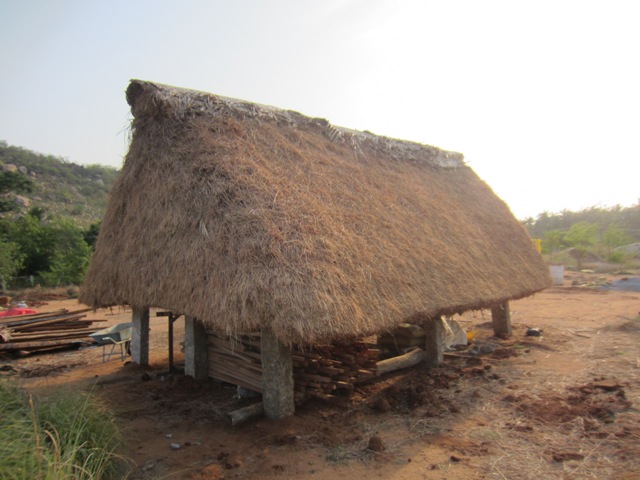
Before we could start constructing our house on the farm, we needed a sheltered space close to the building site. So we decided to build it the local way. I scouted the nearby areas for unused ancient stone posts. People here used to live in traditional thatch houses before moving into their modern concrete blocks. So it was not very difficult to find 12’ and 6’ posts (the center posts are twice as tall as the side ones, so that we achieve a 45 degree slope for laying thatch).  

Our basic rectangular structure consists of stone posts erected along the periphery.  A ridge beam (a thick palm log cut in half) is placed on the center posts and sleepers are placed on the side ones. Eaves are made of palm rafters by jointing two rafters with a nut and bolt. The joint is placed on the ridge beam and the loose ends are placed on the sleepers. The eaves are 2’ – 3’ apart. Long sticks of a local tree called oodaga(Telugu)  or avunji (Tamil) are used as purlins. This wood is pliable, light-weight and termite resistant. The purlins are sometimes nailed to the rafters. Mostly they are tied with a vine called karuppu-kodi or with jute rope.  Purlins are about a foot apart. Once the framework is in place, woven coconut fronds (keethu) are laid on it going from bottom to top. This forms a mat on which thatching is done. 

The picture below shows the keethu roof from inside the structure:


Lemon grass is used widely in our area for thatching. This is a cluster grass that grows wild after the rains. Each cluster can grow up to 6’. Mature grass is harvested and made into bundles of approximately 10 cm diameter. These bundles are trimmed at the bottom before use, as shown in the picture below:

The grass is tied to the existing keethu framework using young date palm fibers (kasangu). First, the ends of young date palm fronds are cut off and then the leaf is divided in half. The “spine”, or stem,  is softened by running it along a hard surface, as shown below:


Prepared kasangu have to be kept moist. Dried ones can’t be used for tying purposes. 

Before thatching can start, all the edges of the roof need to be raised. Long oodaga/avunji sticks are encased in lemon grass to form long and sturdy bundles. These are now tied to the bottom-most purlin:

Unwoven coconut fronds can also be used to create this bund. 

The first layer of lemongrass bundles (tightly tied) is placed on this bund. The top part of these bundles are pressed down with the oodaga/avunji purlins and sewn using kasangu. A thick long iron needle is used to sew. During this first step of the thatching process, the thatcher stands just outside the structure aligning himself to the edge that he will be working on; he has a helper standing inside the structure. The thatcher pokes the roof sending the needle inside with a kasangu fiber. His helper standing under the roof, releases the needle by holding on to the kasangu fiber. The thatcher yanks the needle out and pierces the roof again, a few inches away from the earlier point. The helper re-threads the needle with the kasangu end that he is holding on to. The thatcher yanks out the needle again; with the kasangu that he just received, he ties the grass to the purlin tightly. While such natural fibers are used, instead of tying a knot, thatchers usually twist the strands tightly and push the twisted pair into one of the strands that is being tied. Knots are not used since the fibres can break off. 


After tying the first layer of bundles, the thatcher climbs up, sits on the roof for the rest of the process. He receives the bundles (loosely tied) that are tossed by his helper, who is on the ground. Once he receives a bundle, he unties it and lays the loose grass 6”-8” from the bottom of the previous layer. He obsessively arranges this new grass by interlocking it with the existing material. He has a homemade “bat” that is used to beat the bottom part of the new grass, to push it up, snug and neat into place.


After completing this process end to end on one side for one layer, the team moves on to the other side. The roof is loaded evenly.

To cover the ridge cap, a nice platform is first built using short and fat leftover purlin sticks. One side of these short sticks are made pointy and they are poked (1’ apart) on either side of the ridge beam. These sturdy purlins that stick out form a platform on which a cap can now be placed. The cap consists of three layers, from bottom to top:
  •  keethu tied in pairs and spread out like wings on either side leaving the center part exposed;
  • Lemon grass bundles at the ends (front and back of the structure) to form the apex and lemon grass laid loose in the middle running the entire span, between the two ends
  • Keethu pairs covering the lemon grass below. This layer is tied securely from one end to the other using the purlin stakes that are sticking out, in a zig-zag manner


This structure has been our primary storage during house construction; it has also served as a resting area. It has been a source of great pleasure for me to see the construction workers rest here after lunch.

An expert thatcher Subramani is in his mid-seventies. We call him Anna (meaning “older brother”). I find his dedication toward work infectious. He once told me that good work fills him up and so he doesn’t mind skipping meals at such times. During this project he used to show up at our place by 5:30 a.m. He walks 3 k.m. to get to our place. He starts his work before sunrise and breaks around 10 a.m. to have some idli. He chews on tobacco and areca nut while at work. He takes a short nap after lunch and resumes work. Typically he works till sunset. He is quite comfortable climbing heights, doing extended hours of physical labour, working in the scorching heat (it was 110-115 F, when we were thatching). We have had visitors that are one-third his age who have difficulty doing a fraction of the physical labour that Anna does!

Unfortunately, there are very few thatchers now in this area. The next generation won’t take it up. I fear that this ancient skill may soon not be available. Like with many indigenous skills and ways of living, it is looked down upon to live in a thatch house. Subramani Anna has built hundreds of thatch houses and structures. He acknowledges that thatch roof is  cool  and ideal for our hot summers. Yet, he doesn't want to live in a thatch house for fear of being looked down upon. He once told me that his children wouldn't have got married if he had lived in a thatch house! He said that it was considered as a sign of poverty and nobody would marry in to such a family.


- Hema